- September 15, 2026

-
-
Loading
Loading
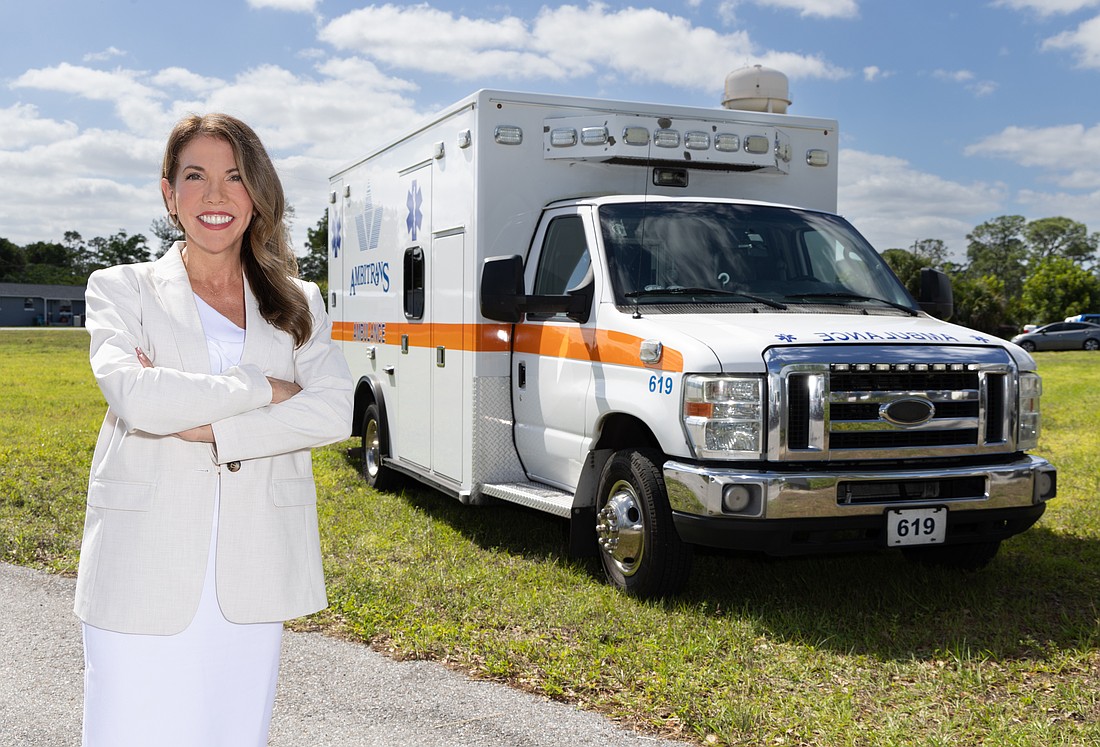
There were a few things Vanessa Oliver was sure she would never do after graduating from the College of William & Mary in 2003 and the University of Florida Levin College of Law in 2006.
“I swore I was never going to come back to work in Charlotte County,” she says, “and I swore I was never going to work for the (family) business either.”
Adds Oliver, with a smile: “Famous last words.”
Oliver has now done both those things: She’s the CEO of Charlotte Harbor-based Ambitrans, the largest private non-emergency ambulance transportation provider in Southwest Florida, with 24/7 service across Charlotte, Collier, Lee, Manatee and Sarasota counties. The company was founded in 1983, back when it had one van and provided wheelchair and non-medical stretcher services.
Ambitrans has been in Oliver’s family since 1988, when her father, Michael Grant, acquired it, under the entity Grant Medical Transportation. (Grant and Oliver share another career highlight — in politics: Both have served in the Florida House, Grant in two stints, last leaving office in 2024, and Oliver is the current representative for District 76, which encompasses DeSoto and parts of Lee and Charlotte counties; both are Republicans.)
Oliver, 45, has worked for Ambitrans since 2012 and was named CEO in 2020. While growing rapidly — partially in lockstep with the region’s population surge — the company faces a core issue that plagues many businesses: finding and retaining top people. For Ambitrans, that means paramedics and EMTs.
“Labor,” Oliver answers when asked what her company’s biggest challenge is. “100% labor. The biggest challenge is finding people.”
Ambitrans currently has about 300 employees — a 68% jump in payroll from 179 employees in 2022, says Oliver. That’s mostly in response to a 46% surge in transport calls since 2020, an increase Oliver projects will only continue to grow in the coming years, given the growth in standalone ERs and other medical centers in the region. Those facilities make up the core of Ambitrans’ transport runs. “The growth has been pretty phenomenal,” Oliver says. (Company officials decline to disclose specific revenue figures.)
A large portion of the 300 or so employees at Ambitrans are EMTs and paramedics. The difference between the two lies in education and training. An EMT, or an Emergency Medical Technician, provides basic life support, such as CPR or bleeding control. Paramedics provide advanced life support, such as starting IVs and providing medications.
About two-thirds of the medical personnel at Ambitrans are EMTs, with one-third being paramedics. That’s similar to the national industry breakdown. There’s about 384,000 EMTs nationwide, which translates to 66.5% of all emergency services personnel, according to the National Registry of Emergency Medical Technicians, a nonprofit, non-government certification organization. There are about 147,000 paramedics, which is 25% of the industry, NREMT data shows.

The labor and retention obstacles Oliver and Ambitrans face, in growing and maintaining a top-tier medical services workforce, is a mix between industry and internal challenges.
On the former, the emergency medical services employment sector has been going through a major transformation — and labor shortfall — since the pandemic. Reasons for that, according to industry research journals and articles, include lower pay than many other health care fields; high stress and burnout levels; and a graying of the industry with retirements and exits outpacing new entrants.
One standout data point: A NREMT survey in 2024 of some 30,000 emergency service workers found 7.1% of EMTs and 7.9% of paramedics were likely to leave the field in the next 12 months.
“It’s no secret — the EMS community is hemorrhaging people,” writes Skip Lockwood, a past president of the National EMS Management Association who has been in the industry for 50 years, in a post on industry news website EMS 1. “As the economy improves, more and more opportunities, with better compensation, are available. Credentials such as registered nurse, physician assistant and several allied health professions — all of which typically pay 30-50% more than paramedic salaries in most communities — are within reach of motivated paramedics.”
Ambitrans faces the internal challenges of maintaining and growing its workforce amid that backdrop.
The company made a big move in that area earlier this year, when it announced a $3 per hour wage increase for licensed paramedics. Even before that raise, impacting dozens of employees, Oliver says the company has long been on the higher side of the pay scale in the industry.
“Licensed paramedics are essential to medical transport, and maintaining consistency and experience on our teams requires thoughtful investment,” Ambitrans COO Ryan Lybeck says in a release announcing the raise. “Compensation, education and advancement opportunities all play a role in that.”
Oliver, in an interview, enhances the education and advancement component, saying she believes the company’s culture is the key to its success in employee retention. “We probably pay the most of anybody in the state,” Oliver says, “but it’s also important we create a good place to work where people feel valued and there is upward mobility.”
One example of the value side: the Ambitrans “hats off to you” program. This, Oliver says, happens when an employee gets a good review or report from a client or a supervisor. The company then gives the employee a new Ambitrans cap, so “everybody knows you did something good that day,” Oliver says. It’s a small token that goes a long way toward creating a space where employees feel recognized, she adds.
Another component of creating a strong culture, Oliver says, lies in the company's mission of taking care of patients. She says in her role as CEO that focus is paramount, in everything from investing in new equipment over having a fancy office to interactions with staff.
“We are always going to do everything we can do to take care of the patient. That’s the only reason we are in business,” she says. “I’m always telling people, ‘My job is to take care of you. Your job is to take care of the patient.’
Finding the people to take care of the patients at Ambitrans isn’t as linear as the culture, Oliver says, with a bit of a “throw spaghetti at the wall” approach to see what sticks in employment recruitment. Referrals are a big source of new employees. Other methods include data targeting and keyword ads; indeed job ads; and hiring recruitment firms. “There just hasn’t been as many people in the field after Covid,” Oliver says.
One plus among the minuses: “This,” says Oliver, “is one job AI is not replacing.”
Oliver, per her promise to herself, wasn’t even going to be in this business — though she says she doesn’t regret the career change.
From 2008 to 2012 she was a civil litigator with Bowen|Schroth, a law firm outside Orlando. Her parents called her and asked her to come back home, work for the firm and help with complicated Medicaid compliance issues. Oliver had worked for Ambitrans as a teenager, doing everything from data entry to washing ambulances.
Oliver came back to the business, and when Grant, her father, chose to slow down a bit six years ago, she was named CEO. Oliver marvels at what her parents built, saying the business the couple bought in 1988 was run out of a garage with three employees.
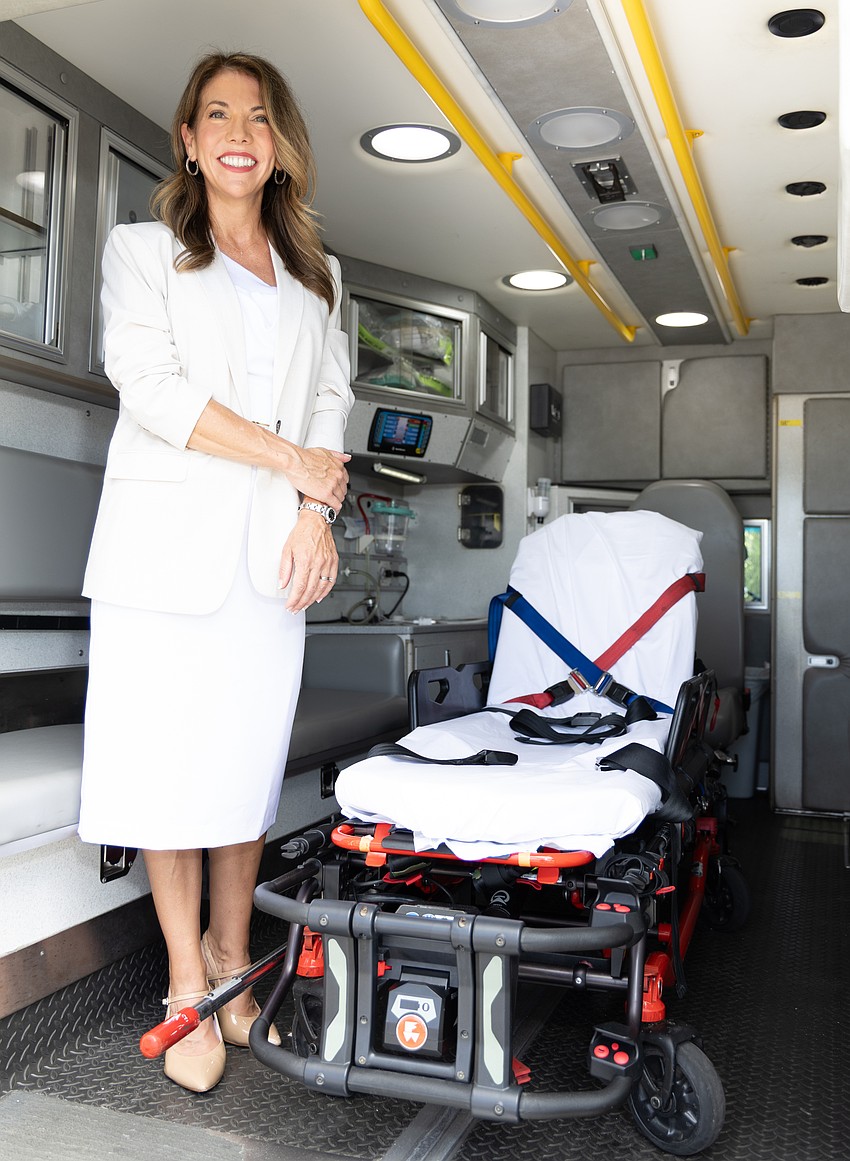
Now, along with the 300 employees, Ambitrans has 45 ambulances — some cost $120,000 each — in addition to two bases and two lifts for in-house vehicle maintenance. The company has four mechanics on staff.
The growth to markets south and north of the Charlotte Harbor headquarters has been organic, and Oliver doesn’t rule out more growth if staffing needs are met. The company gets paid in the form of Medicare, Medicaid, the VA, private insurance and self-pay. “Every time we’ve expanded,” Oliver says, “it’s because a hospital has asked us to come to help them.”