- September 18, 2026

-
-
Loading
Loading
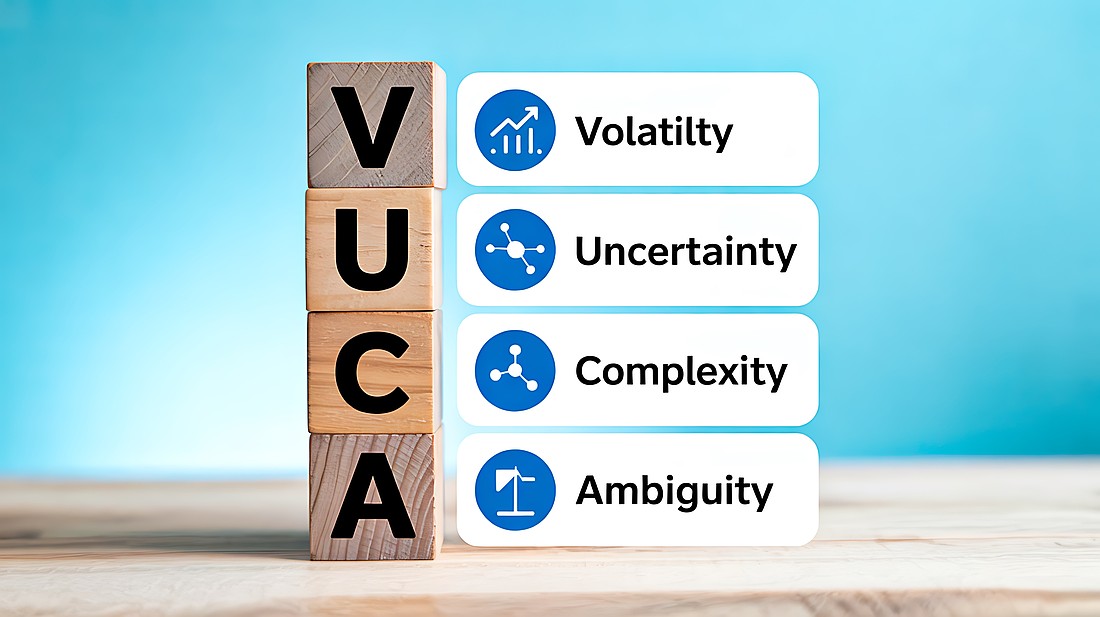 Photo by Zeeshan
In last year’s column, “Navigating a whitewater world: Leadership in uncertain times,” we argued predictable, incremental change is no longer the norm. Leaders today operate in conditions defined by constant disruption — where adaptability, resilience and the ability to lead through complexity are no longer differentiators, but baseline expectations.
One year later, that reality has only intensified.
Across industries — from professional services and health care to construction and nonprofits — leaders are navigating environments where plans rarely hold, timelines shift, information is incomplete and the pace of work continues to accelerate. Change is no longer episodic; it is continuous. And where change persists, uncertainty follows.
This is the essence of what is often referred to as VUCA: volatility, uncertainty, complexity and ambiguity — a term that has moved from military origins into everyday business language.
While organizations often focus on managing change, the more significant challenge is managing uncertainty. Humans are remarkably capable of adapting to change — especially when direction is clear. Uncertainty, however, introduces something different: ambiguity without resolution. It is in these gaps anxiety grows.
When information is incomplete, the brain fills in the blanks. Too often, it does so with self-doubt: Maybe I’m missing something. Maybe I’m not equipped for this. The result is familiar-overthinking, overplanning, hesitation, withdrawal or attempts to regain control.
Now multiply that across a leadership team.
What emerges is not just individual stress, but organizational friction: slower decision-making, reduced confidence and diminished capacity to execute.
Leading in this environment requires a dual focus: managing your internal response while guiding your team through external ambiguity.
Leaders must regulate their own thinking and emotions while simultaneously acting as sensemakers, stabilizers and decision-makers — often without the benefit of complete information. In response to VUCA conditions, many leadership frameworks point to what is known as VUCA Prime: vision, understanding, clarity and agility.
But these are not abstract ideals. They are practiced behaviors.
Leadership starts internally. Before leaders can create clarity for others, they must first create steadiness within themselves.
These practices are not about eliminating discomfort. They are about increasing your capacity to lead through it.
Just as important is how leaders translate that internal discipline outward, through communication, structure and presence.
When these practices are absent, uncertainty compounds. When they are present, uncertainty becomes manageable — and, in some cases, even productive.
External uncertainty and internal doubt are tightly linked. Left unmanaged, they reinforce one another — driving either disengagement or reactive control. But when approached intentionally, they create a powerful leadership opportunity.
The differentiator is not the absence of uncertainty. It is how leaders respond to it.
In today’s environment, leadership is less about providing definitive answers and more about creating the conditions for effective action — clarity where possible, alignment where necessary and confidence grounded in shared capability.
As Viktor Frankl wrote, “Between stimulus and response there is a space. In that space is our power to choose our response.” For leaders, that space is where influence lives.
Uncertainty is not simply a condition to endure. It is a context to lead within. And for those willing to engage it directly, it becomes a catalyst — not just for resilience, but for stronger, more adaptive organizations.