- September 16, 2026

-
-
Loading
Loading
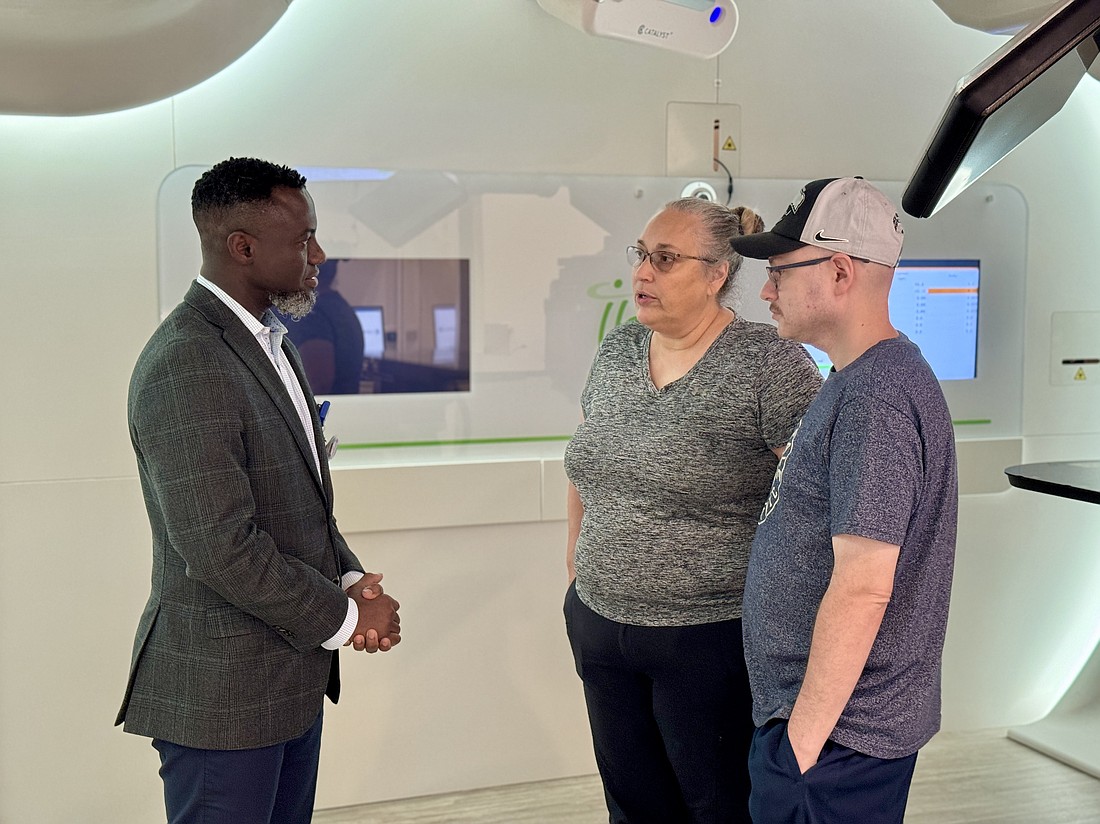
Alex Shaffer was first in line.
Unfortunately, it wasn’t for a roller coaster or concert tickets or even a new store opening. But, if you think about it, being first in this line has much greater rewards.
You see, the 35-year-old Pasco County resident has an atypical Grade 2 meningioma, a rare type of brain cancer. He was diagnosed in 2017 and has already undergone two rounds of radiation treatments.
The treatment, says his mother, Cindy, is a difficult one because of the brutal nature of radiation that affects not only the tumor but the healthy cells around and behind it.
But it’s not only the damage to the cells, Cindy says about two weeks before Alex was set to begin a new form of radiation treatment at Moffitt Cancer Center’s Speros campus. “It’s psychological. It’s physical. It’s emotional.”
The new course of treatment — the one for which Shaffer was No. 1 in line — is proton therapy.
What it does, says Moffitt, is allow doctors to pinpoint the treatment of tumors in the body. Unlike more traditional radiation therapies, by using “high energy X-rays (photons), proton therapy harnesses charged proton particles to deliver radiation directly to a tumor.”
Kosj Yamoah, the chair of Moffitt’s radiation oncology department, says the technology allows the doctors to then focus on the tumor and avoid the collateral damage to other cells.
For example, if a patient has tumors on their liver, the doctors can work to destroy them without the fear of damaging the organ further. Without having to deal with the side effects from that damage, Yamoah says, the patient also recovers faster.
The treatment is being administered at Moffitt’s new 30,000-square-foot Richard M. Schulze Family Foundation Proton Center, a facility that officially opened July 23 and began treating patients July 27. The center is at the cancer center’s 775-acre Speros campus, which is currently under construction off of Ridge Road in Pasco. (Richard M. Schulze is a Naples and Minnesota-based philanthrpiost who founded electronics retailer Best Buy.)
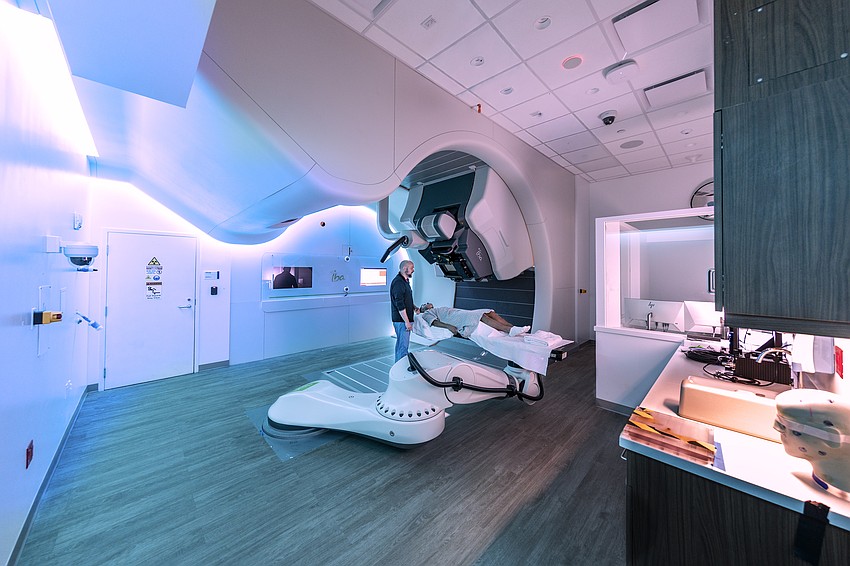
The work is done in a small room bathed in a dim light on the second floor of the center. Patients lie on what’s called a couch under what appears to the uninitiated like a giant camera but is actually what delivers the radiation.
The couch, says Yamoah, moves around as needed to best ensure the treatment is at its most effective while keeping the patient comfortable.
It seems simple. But it’s not. Not by any means.
That room, and the work done there, are the results of two major undertakings — one medical, the other structural.
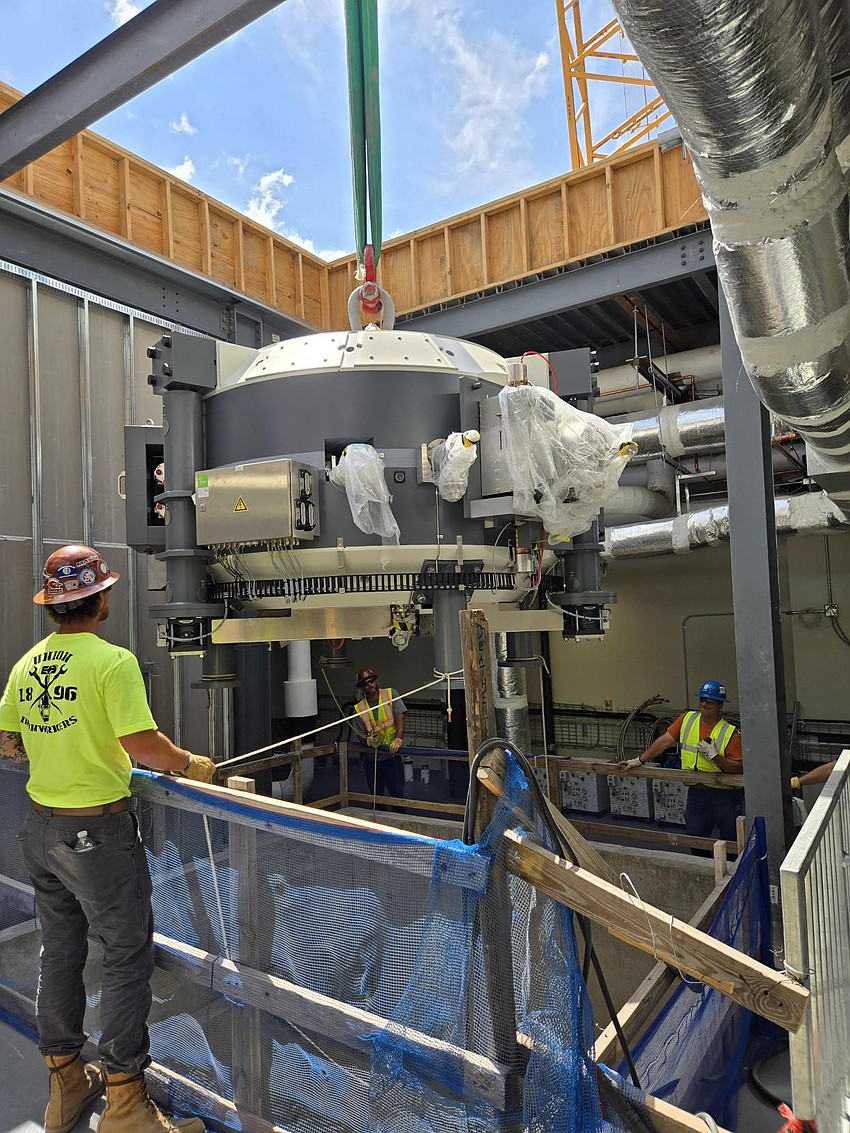
For the structural, while what you see in the treatment room may seem like a giant camera, it is actually an arm at the end of a three-story machine that had to be brought into the building by a crane.
It is called a ProteusOne system and was designed by a Belgian company named IBA that shipped it to Moffitt. The system is made up of a 55-ton superconducting synchro cyclotron and 110-ton gantry.
According to Moffitt, “at the heart of the machine is the innovative pencil beam scanning method, an advanced technique that delivers protons in ultrafine layers.
“This method uses a narrow, magnetically guided proton beam that ‘paints’ the tumor with pinpoint accuracy and allows millimeter-by-millimeter tumor targeting.”
This is done by using magnets that, Yamoah says, shapes the beam and directs it where it needs to go. “That's how it's able to come through the nozzle and really deliver the dose and stop right where it needs to be and (affects) nothing else beyond that.”
(There are two other ProteusOne systems in Florida. One, in Estero at Southwest Florida Proton, is part of an $80 million project that treated its 100th person earlier this year. The other one is at the UF Health Proton Therapy Institute in Jacksonville.)
As for the medical side, it would be understatement of vast proportions to say planning the treatment is a complicated process.
Before a patient is brought in, doctors work to create 3D reconstructions based on the patient’s anatomy and the tumor. It’s called contouring and is like a virtual surgery, Yamoah says.
The idea is to know exactly what the shape of the tumor is. That’s critical because there are no universal dimensions, each is unique. The imaging is done to make sure everything is marked and identified.
That information then goes to Moffitt dosimetrists. These are members of the radiation team who, according to the American Association of Medical Dosimetrists, are trained in math, physics, anatomy, physiology and radiobiology.
Yamoah says they will plan exactly how the beams are supposed to come in at different angles, at what speed and velocity and where they are supposed to stop — and shouldn’t stop.
Once that is completed, the plans are reviewed by medical physicists who simulate exactly how the therapy is delivered and measure the output to make sure it is accurate. This also happens before a patient walks in for treatment.
And when the patient does walk in, an algorithm is already locked into the computer system to deliver the treatment. While the system is accurate within a millimeter, there is real time human interaction as the treatment is ongoing to monitor how the tumor responds and make adjustments as necessary.
As effective as proton therapy can be, it does not work for every cancer patient, though.
While it can treat cancers from head to toe, as well as the skin, it’s all about the location of the tumor. Take a tumor in the lung. As you breathe, that tumor moves, making it difficult to pinpoint in a system based on precision.
Yamoah recommends patients discuss their options with their doctors to determine whether proton therapy is a viable treatment. “When you find the right patient and the right tumor, this is second to none,” he says.
For now, Moffitt has a waitlist and Yamoah estimates it will complete about 6,000 treatments per year. That breaks down to treating 400 to 500 patients a month and about 25 treatments per day.
And as for the hoped for results on Alex Shaffer, who was first in line for the system?
Cindy Shaffer says her son's tumor, medication and past treatments sometimes made him aggressive. She’s hoping the proton therapy will alleviate some of that and allow him to stay home because of his special needs.
Like any parent, she wants him to have the best life he can possibly have and to “continue to do the things that we all take for granted in life.”
“Do we think that there's going to be some side effects? We're not that stupid,” she says. “Yes, we understand that there will be, but we're hoping that this treatment will minimize that.”
As for Alex, a childhood leukemia survivor, his hopes for proton therapy are simpler.
“I hope it helps my brain tumor,” he says. “I’m tired of it growing.”