Postcard company seeks to capture $500K in revenue — for starters — with AI shift

A legacy industry like postcards in your mailbox doesn’t seem ripe for the AI revolution. But some trial and error led one Clearwater company to a different result.


  • By
  • | 5:00 a.m. May 20, 2026
  • | 1 Free Article Remaining!
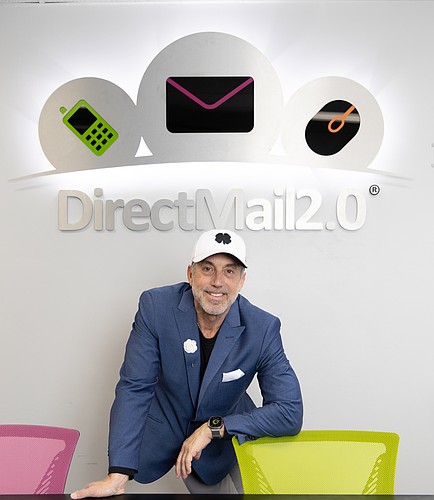
Brad Kugler says working with AI takes a lot of trial and error.
Photo by Mark Wemple
  • Tampa Bay-Lakeland
  • Share

Clearwater-based entrepreneur Brad Kugler’s origin story perhaps holds one key lesson: knowing when to shift. 

Before becoming CEO and co-founder of digital marketing platform DirectMail2.0, Kugler spent 20 years in an industry that would become obsolete: selling prerecorded digital media, like CDs and DVDs and video games. In 2012, the company hit its peak, doing roughly $25 million in revenue a year. But with the introduction of streaming platforms and a change in how entertainment was consumed, Kugler saw the inevitable direction — and it wasn’t an outlook he liked. 

By 2017, he was on the hunt for a new business. This time, he wanted to be the disruptor, not the disrupted. His longtime friend Joy Gendusa, founder and CEO of Clearwater print marketing company PostcardMania, came to him with an opportunity — she had hoped to spin off an arm of the business into a marketing platform, helping improve the response rate of mailers and managing analytics for direct mail campaigns. 

That business, named DirectMail2.0, has since turned into a larger enterprise, sold to 300 resellers who then market it out to 6,000 clients. In total, the company has managed roughly 80,000 direct mail campaigns, Kugler says. But it’s a business that, while not shrinking, is certainly not growing rapidly. And Kugler was looking for his next opportunity. What he landed on involved two of the biggest buzzwords of the last few years: artificial intelligence. 

“I knew that I wanted to take the data that I’ve been acquiring on these 80,000 campaigns and monetize it. Of course, AI comes — I could model future campaigns based on past results with some sort of accuracy,” he says. “This is not something that ChatGPT or Anthropic or Google can do. They don’t have the data I have.” 

Kugler’s vision was to create an AI product that would allow companies to input a prospective design into the system and prompt them with suggestions that could improve their results, based on data from similar mailing initiatives. As part of this move, DirectMail2.0 acquired mailing institution Who’s Mailing What in May 2024, hoping to leverage the company’s additional data to create its AI-powered system. 


Real impact

But when the team began work on the new product, aptly named DM20.ai, their beta testing revealed an unexpected problem — the suggestions were overly simplistic (add a phone number to your postcard) or the system was being stumped by small differences (unable to read a telephone number with periods instead of dashes). 

“It’s trial and error,” Kugler says, reminiscing on the six-month beta testing. “And you’re having to do some of this stuff with live people.” 

Through feedback from clients and the company’s own testing, the DM20.ai team tweaked the model to ensure that the system’s suggestions led to tangible next steps that would actually improve direct mail based on previously reported data. The product launched at the beginning of March. 

“That’s when we got to the line of something of value and sellable,” Kugler says. 

DM20.ai’s product allows the client to upload an image of their potential mailer and answer eight questions about their target — questions like date of mailing, target geography and mailing class, for example. 

Brad Kugler has been in the direct mail business for nearly a decade.
Photo by Mark Wemple

Kugler uses the example of a landscaping business that may want to send a mailer out around spring clean-up. He can use data from competitors in a 50-mile radius to see what’s worked and what hasn’t. And when the client uploads their potential design, it gets ranked by the system on a scale of one to 99. DirectMail2.0’s average mailing size is roughly 17,000 pieces, so if the client is able to make some adjustments that translate to better sales, this can have real fiscal impact. 

“The value proposition here is for $50 or $99, so if you can test that and see how it scores compared to similar mailings at similar targets, is that worth $50 or $100 when you’re about to drop $5,000?” Kugler asks. “If you can come up with a few points to increase the likelihood that you’re going to be successful, you’re talking about a fraction of a percent of your budget.”


Market reach

Currently, DM20.ai offers a free trial analysis for all potential clients at a $99 value. Companies that want more depth or another report can pay for various levels of reports, from $19 to $99, utilizing different language learning models like ChatGPT or Gemini Pro. Clients can also purchase monthly subscriptions that range from $99 to $499, based on amount of usage per month. 

The company currently has a handful of paying customers, though Kugler says it's not ready to disclose financial numbers as many clients remain on a trial period. Its initial plan was to approach various longtime commercial printing clients that could purchase access to the service and then white label it to their own consumers. 

So far, at least two local printing companies DirectMail2.0 already works with have used the tool with clients. Phil Vedda, vice president of family-owned Cleveland-based commercial printer Vedda Printing, found the tool immediately “user-friendly” and “quick.”

For the moment, his office is using it on a per-project basis, but he’s already had good results. On a recent mailer for a theater company, DM20.ai noted that theater campaigns typically dedicate 30 to 40% of front panel space to the material while this particular flyer had only used 8%. 

“It’s a small price to pay, because anytime you’re doing direct mail, you’ve got a lot of expense coming your way,” Vedda says. “You’ve already invested in the design, bought a mailing list and digital technology, so what we’re thinking is this is a small investment, if you can get a couple things out of it or even just peace of mind that what you’re putting out there is going to get a return for you. 

At Ohio-based marketing firm Think Patented, director of sales Terry Bouquot was involved in the beta testing for DirectMail2.0’s AI product and was impressed by the final version. The company has also signed an annual subscription for the next 12 months. Rather than upcharge customers, their plan is to offer the service already included in their printing as a differentiator from competitors. 

For Kugler, the future seems limitless — or at least, he sees even more expansion possibilities. His hope would be to eventually create a system where the AI itself could propose, design and mock-up a model for mailing campaigns within the very same tool. 

But for the moment, he’s focused on the recent launch of DM20.ai and seeing where that can go.

“Honestly, if I can generate a half a million dollars this year from this platform, I’m golden,” he says. “It’s a very self-service platform. It does not require a lot of handholding or support. It’s all automated, so there are very little labor costs.” 


Latest News

Sponsored Content