- January 27, 2026

-
-
Loading
Loading

Leadership consultant and keynote speaker Julie Henry wasn’t necessarily planning to write a sequel to her debut book on leadership, “Wisdom from the Wild: The Nine Unbreakable Laws of Leadership from the Animal Kingdom.”
Published in late 2021, the book is a deep dive into something Henry, president of Sarasota-based Finish Line Leadership and JH Global Inc., had been doing for much of her career: linking nature to leadership. It also was a hit, ranked as an Amazon bestseller in Biology of Wildlife and business mentoring and coaching, and a 2024 Best Business Minds Book Award winner.
Henry, who worked in senior-level roles at aquariums and zoos prior to getting into consulting, based the book on both her life and work experience. Consider one chapter focused on leaders grappling with a fear of spiders. The theme is to accept, but not be distracted, by fear, so you don’t miss the opportunity behind being scared. The parallel point: Not all spiders are bad. Which leads Henry, in the book, to write fear can be “nature’s built-in yellow light, reminding you to slow down and pay attention to the opportunities for change that sticks.”
Like all good sequels, even unexpected ones, Henry’s latest book has a twist: it was written in conjunction with her two teenage children, Tasman and Kepler. (Tasman was 17 and turned 18 when she worked on the book; she’s now a freshman at Florida Gulf Coast University; Kepler was 15 and turned 16 while he worked on the book; he’s now a junior in high school.) The book is called “Wisdom from the Wild for Youth: Leadership Tales with Tails.”
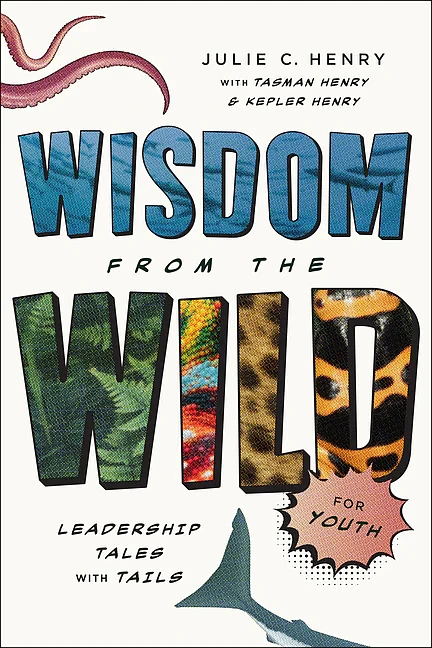
It was published in September. While geared toward teenagers and young 20-somethings, Julie Henry has seen grandparents buy it for little kids and others purchase it for tips for parenting teens. “I hope people who read this will see leadership in a new light,” she says, “and a new way of thinking about leadership.”
On a personal level for Julie, even more important than the book is the experience writing it with her children. “I believe in the message,” she says. “I believe in this book, but if I never sold one book or made any money of it, I will always be so glad I did this. These are some core memories. I learned a lot about my kids and I think they learned a lot about me.”
While this book, unlike her first one, isn’t geared toward adults, there are some themes and points that should resonate with any leader at any age and stage of their career.
This is illustrated early on, in Julie’s voice in introducing the book. “Leadership can be as hard as it is exciting, so let’s spend some time laughing about ladybugs and cacti as we learn leadership skills,” she writes. “Nature also helps level the leadership playing field. It doesn’t matter how long you’ve held a leadership position, how much time you’ve spent studying leadership, or even the number of years you’ve lived on the Earth; nature can always be a common ground to have conversations about leadership principles.”
Three more points, called bottom lines in the book, include:
Leadership tale No. 2, detailing myths and realities of leadership by swimming with sharks, I think, is a key lesson of the book. The chapter is subtitled: Leaders come in all shapes and sizes…but still have a few things in common.
The authors point out there are 500 species of sharks, some wildly different from others, that all share five defining traits. From a carpet shark lying on the ocean floor to a megamouth swimming in the deep sea, all sharks have a skeleton made from cartilage; five to seven pairs of gills; rigid dorsal fins; no swim bladder for buoyancy; and skin covered with dermal denticles.
“And just as there are at least 500 different types of leaders, all leaders,” the authors write, “share five defining characteristics.” Those characteristics form a neat acronym in the book and are on point for defining good leadership.
Another important lesson, or tale, in the book is the chapter that connects leading as you are to poison dart frogs, Tale No. 6. The core point? Leaders need to be present, prepared and purposeful.

Poison dart frogs, writes Julie, “don’t vocally announce their presence, engage in behavior that might indicate they’re poisonous, or in any other way shout from the rooftops that they are there. They simply are. The most impactful and influential leaders I know, teach and coach are the ones who do not have to tell people they are the leader. They simply act as the leader they are. When they are in a room, they are the ones who carry themselves with confidence, whether they are gregariously interacting with everyone in the room at once or quietly engaging with one person at a time. They are the ones who are on time, pay attention, actively participate and remember people’s names.”
The chapter further breaks down your leadership presence into four buckets, to help people think actively about what you need for a given situation. Those buckets include:
From sharks and spiders to bats and bugs, those buckets, like most other parts of the book — and Julie’s first book — work in unison to showcase the core message the Henrys are conveying: leadership comes in many shapes, sizes and situations.
“Leadership is not a list of bullet points, step-by-step directions, or even a cookie-cutter plan to follow each time,” the mother-daughter-son trio writes. “Leadership is a critical thinking skill; it’s a choose-your-own adventure activity.”