St. Pete bank posts $19M loss, but execs confident in restructuring

  • By Mark Gordon
  • | 5:00 a.m. November 1, 2025
  • | 2 Free Articles Remaining!
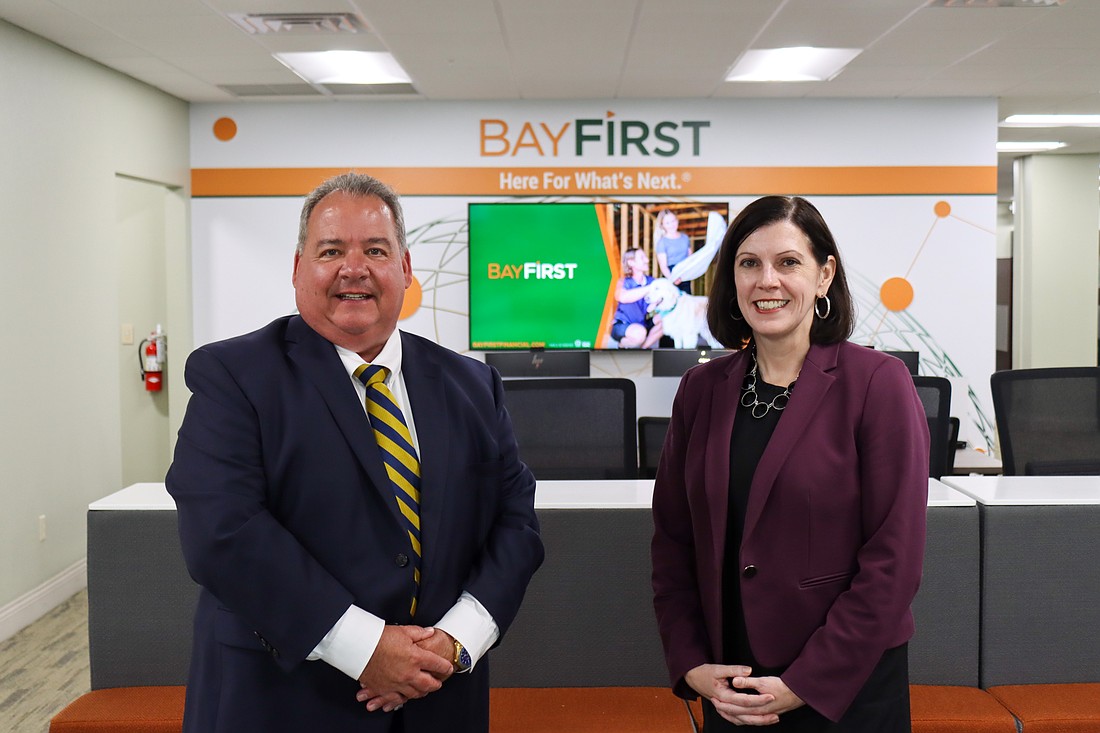
BayFirst CEO Thomas Zernick with President and COO Robin Oliver. The bank had $1.35 billion in assets through Sept. 30.
Courtesy image
  • Tampa Bay-Lakeland
  • Share

BayFirst Financial Corp., the parent company of one of the region’s largest community banks, posted a nearly $20 million loss in the third quarter. 

While lamenting the reasons behind the loss, bank officials are confident the St. Petersburg-based institution, BayFirst National Bank, is well-capitalized and has the right return-to-basics strategy going forward.

The bank reported a net loss of $18.9 million, or $4.66 per share, in the third quarter. That’s a jump from a net loss of $1.2 million, or $0.39 per share in the third quarter last year. The bank had $1.35 billion in assets through Sept. 30, according to Federal Deposit Insurance Corp. data, and $1.16 billion in total deposits.

The reason for the quarterly loss, BayFirst CEO Thomas Zernick says in an interview with the Business Observer, is rather straightforward: the bank is at the end-stages of a previously-reported plan to totally exit the SBA loan business. “While that is a significant loss for our company,” Zernick says, “we do remain adequately capitalized.” 

The SBA loan divestiture — what Zernick called “difficult but necessary” — comes with $12.4 million in one-time charges, including a restructuring charge of $7.3 million. The bank, says Zernick, also “significantly increased our loan loss provision,” in the quarter, “well above our normal provision, to the tune of an additional $8.5 million.”’

The bank reached a deal to sell its SBA portfolio, with about $103 million in loans, in September to Miami-based Banesco USA. The deal is for 97% of the retained loans' balances, or a net loss of $5.1 million, the bank says. Most of the unit’s 65 employees, says Zernick, have been offered employment at Banesco USA. The deal is expected to close by the end of the year. The main holdup, through Oct. 31 at least, the bank says, is the federal government shutdown because the SBA has to process the deal.


Better earnings

Getting out of SBA lending is something of a twist for BayFirst: For roughly a decade, the bank, founded in 1999, was a statewide and even national leader in SBA loans. As recently as fiscal 2023, it was No. 1 in dollar volume among all SBA lenders in the state, according to federal documents. Going back to 2016, the bank was in the top 40 nationally in SBA dollar volume and the top 15 in total SBA loans. Zernick actually oversaw SBA lending for the bank, in what was called its CreditBench division, from 2016 to 2022. In 2022 he was named president and in 2024 he was appointed CEO, after longtime chief executive Tony Leo retired.

BayFirst National Bank was founded in 1999.
Courtesy image

Zernick, in the interview, acknowledged the bank’s onetime SBA prowess, saying SBA loans “helped us grow our bank from $100 million when I started in January of 2016 with two branches to now $1.3 billion with 12 branches.” 

But the SBA market began to sour, Zernick says, in 2022, first when interest rates spiked. When the prime interest rate increased 5.25% in 18 months, some borrowers were “facing monthly loan payments that in some cases almost doubled, and it caused a lot of strain in their cash flow,” he says. That led to a decrease in demand for SBA loans. The SBA market got even more treacherous at the end of last year and going into this year, Zernick adds, listing tariffs, distribution channel disruptions, an increase in the costs of goods and labor costs as more issues.

With the backdrop of “heightened losses in the SBA program causing concerns,” Zernick says he, along with the executive management team and the bank’s board, started to meet earlier this year on a “strategic review of the (bank’s) business model.” The goal? “De-risking our balance sheet and improving the earnings of the bank going forward.”

“We feel like this transition of exiting SBA and the actions we've taken over the last several quarters positions us to be a strong community bank that will focus on the communities we serve in the Greater Tampa Bay area,” he adds. “It's kind of a thoughtful return to who we really are, and that is a strong…and very successful community bank.”


Back to basics

The bank’s losses, from SBA and other factors, reached $20.5 million through the first nine months of 2025, according to public filings. 

But Zernick is confident the bank will return to profitability in 2026.

To get there, sans SBA, the bank, he says, is “going to be known as a community bank, and we're going to be doing basic community bank blocking and tackling.” That list includes business loans, in maintaining its focus on owner-occupied commercial lending and also getting into homeowners association banking and more health care lending; consumer loans; and more residential mortgages. 

Another part of the growth strategy lies in treasury management. The bank doubled its treasury management staff to four and created new product lines earlier this year. It now can service small and medium-sized businesses as well as large businesses through two online platforms, according to investor documents. Treasury management is already on a growth track for the bank, from $20 million in fee income in 2022 to $69 million year-to-date, up 245%.

And even with the stinging quarterly loss, bank officials point to some positive signs in its asset and deposit base: total deposits increased $8 million for the third quarter and $59 million over the past 12 months, while checking accounts are up 6% year to date.

Finally, like many of his peers in community banks, Zernick says BayFirst can compete with regional and super banks on technology without losing its personal feel. “We're always going to be high-touch,” he says. “It's not going to be calling a 1-800 number in another state or overseas. You're going to deal with a local bank with a local board and local employees.”

All these factors and more lead Zernick to be overall positive about the bank going into next year — despite ongoing concerns and future worries, from tariffs to nontraditional banks grabbing market share to interest rates. “We've seen challenges,” he says, “but our board and myself and our senior management team here, we're very optimistic about the road ahead.


author

Mark Gordon

Mark Gordon is the managing editor of the Business Observer. He has worked for the Business Observer since 2005. He previously worked for newspapers and magazines in upstate New York, suburban Philadelphia and Jacksonville.

Latest News

Sponsored Content