- October 16, 2026

-
-
Loading
Loading

The ever-burning flame at the Lena Road Landfill in east Manatee County will be going dark about 18 months from now.
The flame is actually a flare stack that safely releases excess gas from the mounds of buried, decomposing waste, but Manatee County is moving ahead with plans to capture that gas and turn it into a commodity.
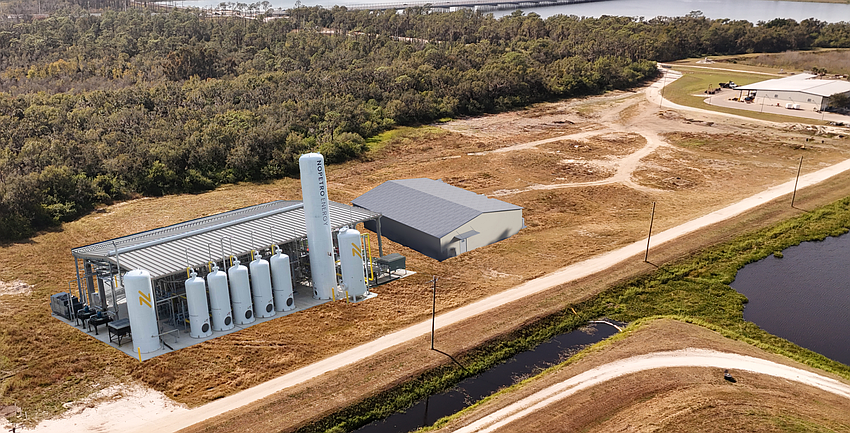
A groundbreaking ceremony was held at the landfill Oct. 9 for a $50 million renewable natural gas facility. At 3333 Lena Road, the landfill is east of Interstate 75 and south of State Road 64.
The facility is the result of a partnership between Manatee County, Johnson Controls and Nopetro Energy. The county provided the land.
Johnson and Nopetro are funding the $50 million project, with Johnson serving as the integrated developer and Nopetro serving as the owner and operator of the plant.
Charles McGinnis, a vice president for Johnson Controls, says Manatee County is guaranteed to collect at least $883,000 in annual royalties once the plant is operational, and that number could increase up to $2.1 million.
In addition to the gas itself, the plant will generate energy credits, which can also be sold.
The Environmental Protection Agency explains renewable energy monetization on its website: A credit is issued for every megawatt-hour of electricity generated and delivered to the electric grid from a renewable energy resource. Selling credits generates revenue, but the seller forfeits “the ability to make any claims about ‘using’ renewable energy.”
For local residents, the project offers better air quality because it will reduce the emissions from the biogas that’s currently being flared into the atmosphere at the Lena Road Landfill.
The plant is expected to eliminate the amount of carbon dioxide that, in comparison, would be produced by 5.3 million gallons of car gasoline each year.
“It’s environmentally great for everybody,” Manatee County Commissioner Mike Rahn says. “It helps bring dollars back into Manatee County, and we get green tax credits that will help bring down some of the costs that we have to pay at the landfill.”
He notes some county equipment at the landfill can be powered using the gas, too.

Rahn says more counties are starting to capture their biogas instead of wasting it.
According to McGinnis, the value of biogas is much higher than it’s been in previous years.
“Because the value of renewable natural gas has increased substantially, now projects have become financially viable that weren’t before,” McGinnis says. “Manatee County is one of those counties that’s at the forefront of innovation, and they saw this happening. They were already taking some of the renewable natural gas and using it themselves in their biosolids drying process.”
According to the American Biogas Council, landfills are the largest source of captured biogas in the United States, “driving record investment” in renewable natural gas production.
The “Biogas in America 2026” report states, “The nation’s 598 landfill gas capture systems provide about three-quarters of all biogas captured in the U.S. and produce 64% of the nation’s renewable natural gas.”
Additionally, developers brought 20 new landfill gas projects online in 2025. One of those projects was led by Nopetro in Vero Beach, in Indian River County.
A year later, Nopetro Energy CEO and co-founder Jorge Herrera says the operation is going so well that Indian River County has been making improvements to its landfill to produce and capture more gas.
Manatee County, company officials say, can do the same.
To simplify a complex system, Herrera says to picture straws. The straws have holes in them, and they can be stuck into the ground throughout the landfill.
More straws can collect more gas. As the organics start to decompose, the molecules get sucked into the straws and moved to the plant to be refined into usable gas
Currently, the majority of the gas produced at the landfill is being burned off into the atmosphere.
Indian River County has a population of about 174,000. Nopetro estimates that its Vero Beach plant can provide as much as 80% of the natural gas used in the county.
Herrera says Manatee County’s production will be about 20% higher, but its population is also 2.5 times that of Indian River. A ballpark estimate, he says, is the Lena Road plant could meet about a third of the county’s natural gas demands.

In 20 years, Manatee County will have the option to either extend its contract with Nopetro or take ownership of the facility. However, the latter is not likely.
“These are very complex assets,” Herrera says. “From that perspective, I don’t think I’ve witnessed across the country an example where a government has taken on the responsibility of a production plant like this because it’s so specialized. It’s basically like saying, ‘Take an oil refinery and run it.’”
Nopetro has been in business for 17 years.
“We didn’t need to become an energy company ourselves,” Commissioner George Kruse says. “We wouldn’t know what we’re doing. We needed to find the right partners, and Petro Energy is bringing its renewable natural gas experience. Johnson Controls helped develop the project and its performance strategy. Mead & Hunt is designing and constructing the facility, and Manatee County is bringing an asset that was here all along. That’s exactly what a public-private partnership is supposed to be.”
A version of this article originally appeared on sister site YourObserver.com.