- September 16, 2026

-
-
Loading
Loading
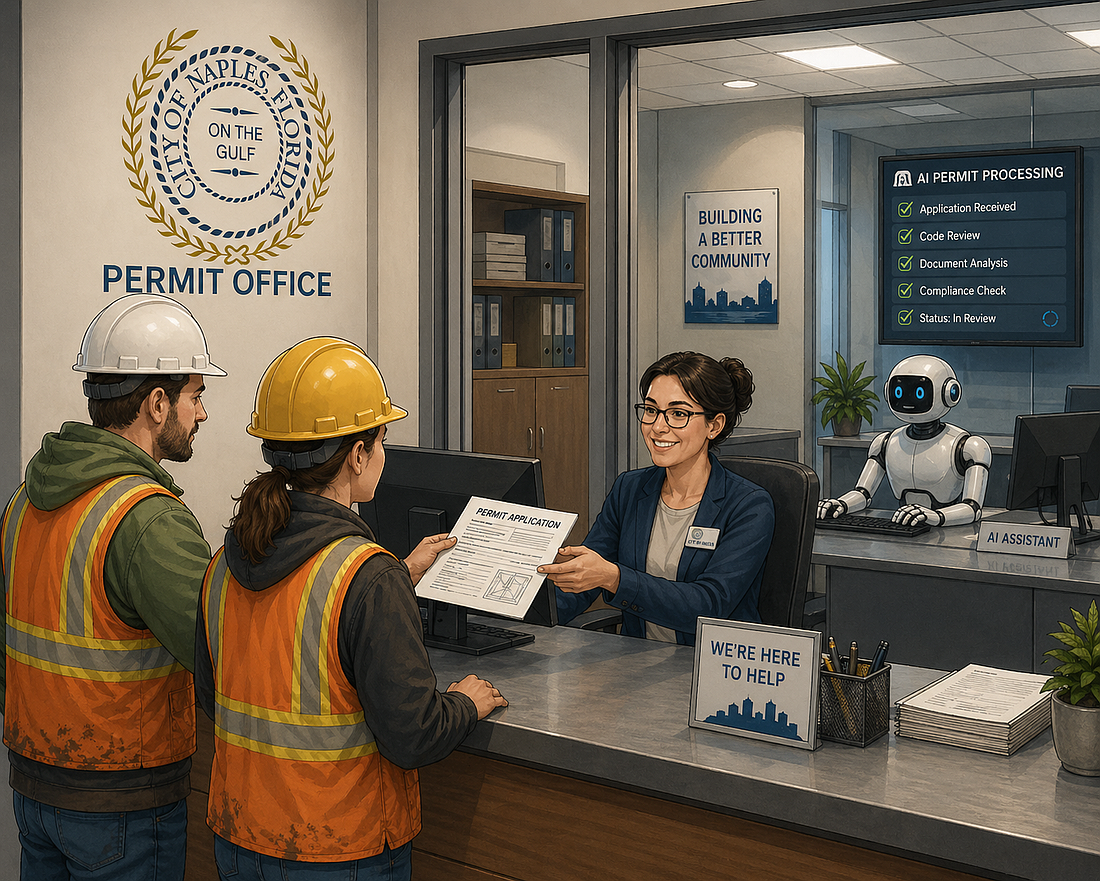
The city of Naples took a big step last year into AI by introducing the technology into its permitting process.
A luddite might say it handed over a piece of its planning department to a robot.
Yet nothing could be farther from the truth, says the Tampa company behind the technology,
“It was intentionally built in a way that this cannot run without human intervention,” says Brittany Griffin, a principal planner at Blitz AI, the company behind the AI.
“So, it's not going to Skynet us," says Griffin, referencing the superintelligence system in the 1984 film "The Terminator" that turned against humans. "It's not going to push us out of a job because a human is going to input the files and then a human is going to analyze the files. For lack of a better term, the AI is producing something as simple as a grocery list of items wrong that the human would have found in a few hours and the AI found in minutes.”
Blitz AI was founded in 2022. it works with local governments nationally to use AI to, it says, improve productivity in development services.
The company would not disclose sales or revenue figures but says it has a team of more than 100 working with localities nationwide. Among its clients are San Mateo County, California; Arlington, Texas; and Pueblo County, Colorado.
The two core components of Blitz AI’s technology are sufficiency and compliance, the company says.
Sufficiency speaks to incomplete or poorly written applications that are submitted to a planning department. The software is trained to look at the submittals for issues and judge them on what a locality expects. It then provides real time guidance to applicants.
That piece, Blitz AI officials say, results in 85% fewer resubmittals.
The compliance piece is the customization. The software, plugged into a locality’s existing development system, is trained on state and local building codes and ordinances. The technology uses that information to analyze plans and produce detailed reports with redlined drawings that flag noncompliance.
Once the report is complete, it is reviewed by a human who then works with the applicant to rectify the issues — if there are any.
That human element is key to making the system work, says Chris Prather, Blitz AI’s vice president of growth.
“If you're going to quote anything, this is where you want to quote: Human-in-the-loop AI,” he says.
“What that means is that this is where a human takes over. The AI gives them a head start, makes them more efficient.”
Human-in-the-loop is not just a company term, it is a concept that stresses the need to keep people involved when technology is in use. IBM describes it as a “system or process in which a human actively participates in the operation, supervision or decision-making of an automated system.”
When it comes to AI, IBM says humans need to play a role in the workflow in order to safeguard accuracy, safety, accountability and ensure ethical decision-making.
In the case of Blitz AI, what the technology is meant to do is create efficiencies by cutting humans out of a piece of the planning process that is both labor-intensive and time-consuming — the initial review of and response to a planning application.
If you're going to build a new house, it takes three or four weeks just to get an initial review done, says Prather, “whereas the AI can do it in a matter of hours or seconds.”
The AI, in other words, does the painstaking work and the human reviews the AI’s output.
“The efficiency gains," he says, "are tremendous.”
A Naples city spokesperson did not respond to a request to interview a planning official for this story. But in a June memo to Naples Mayor Teresa Heitmann and city council, Naples’ director of building services Stephen Beckman wrote that AI improves efficiencies and enhances accuracy and consistency.
“AI has been rapidly developing and being used for enterprise solutions in almost every (if not every) field, trade, industry, and has developed to the point where it can be used to gain incredible advances in efficiencies with permitting and plan reviews at local municipalities,” he wrote.
On June 18, Naples City Council approved spending $514,096 for licensing the technology and to customize its existing CityView system, according to city records.
Naples' “sufficiency review” program is now online and available for use.
On the site, the city is careful to let residents and businesses know that what’s available is a pre-submission tool only and that official decisions are made by city staff.
Correction: This story has been updated to show Chris Prather is the VP of growth at Blitz AI.