
- March 3, 2026

-
-
Loading
Loading

Sometimes, an entrepreneur finds their next idea through dogged search. Other times, it finds them.
Tampa entrepreneur and financial executive Will Freeman came upon his latest venture through a type of happenstance — he was tipped off by a former Nike executive to a public crowdfunding round for an Irish football team.
He was curious.
“I put a couple of thousand dollars in there, didn’t think much of it,” says Freeman, a Business Observer 40 Under 40 winner in 2024. “It was a very passive, tokenized type of investment.”
But that touched off a broader interest for Freeman, who at 28, has already started several businesses; worked for both LinkedIn and Oracle; and been a guest lecturer at the Questrom School of Business at Boston University and the John H. Sykes School of Business at the University of Tampa. So Freeman reached out to some brokers and began to research making targeted investments and acquiring minority and majority ownership stakes in football clubs globally. (Here, football, of course, means soccer.)
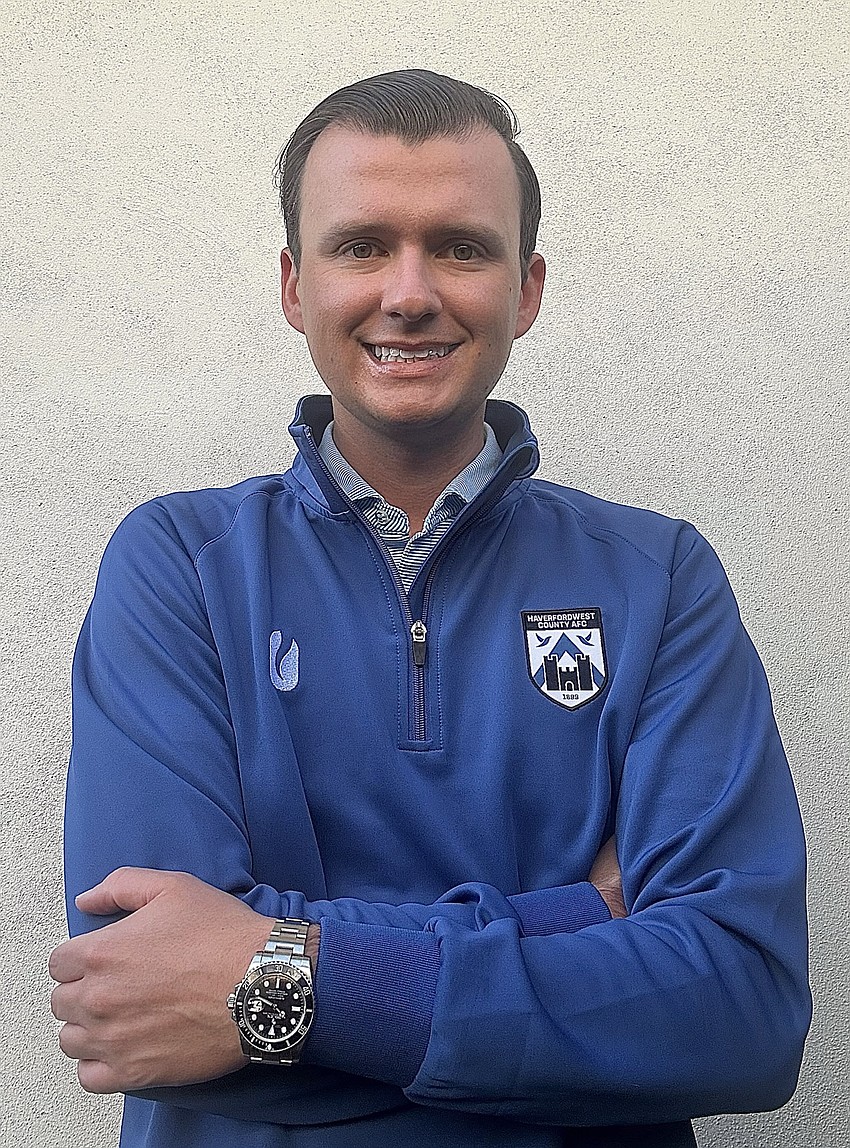
Last October, Freeman made his first official investment, using personal capital, to become a minority owner in Welsh football team Haverfordwest County AFC. He declines to disclose the amount he invested, saying only “top-tier Welsh football is a lot more palatable than English, and the club economics make more sense.”
The investment is just one in what Freeman hopes will be a series of six-figuire investments in emerging football clubs through his latest business, Tampa-based Catalyst Sports Ventures (and not to be confused with his private equity firm, also termed ‘Catalyst’). Through the oft-discussed multi-club sports ownership model, Freeman now looks to pair accredited investors with the unique opportunity to buy partial stakes of football teams in what he deems “undervalued clubs.”
Freeman likens a minority football club investment to investing in a startup: these are alternative asset strategies that could initially be more risky but potentially more rewarding than a more traditional investment, like real estate.
“The ways that people win in this space, especially in the multi-club ownership space, is to grow up the valuation of a single club and to divest that potentially,” Freeman says, “or, which is probably my preferred method, at a point you have a portfolio of clubs and your overall portfolio has appreciated, and then you sell to a larger MCO.”
MCO, meaning multi-club ownership, is an acronym in part because it has become so ubiquitous in the sports world in the last decade. In 2023, the Union of European Football Associations released a report indicating more than 6,500 players were registered with clubs that had a cross-investment or multiclub structure. Foreign management, too, proved common in European football clubs, with roughly 13% under foreign ownership, per UEFA data. (One of the most famous ownership groups ever in European football has a major Tampa connection: The owners of the Tampa Bay Bucanners, the Glazer family, acquired a controlling interest in the Premier League’s Manchester United in 2005.)
“There has been a big increase in recent years — the MCO has probably been the hottest trend in terms of football governance for the past four or five years,” said Fernando Roitman, head of sports intelligence for the Switzerland-based International Centre for Sports Studies.
Florida has already been a hotspot for this kind of sports investing — a 2022 Bloomberg article identified the Sunshine State as a major hub for American investors looking to put money into European football. (Two of these big names, Paul Conway, a co-founder of Pacific Media Group LLC, and Josh Wander, managing partner at 777 Partners LLC, were separately charged with fraud in prominent cases last year each with ties to Florida.)
Roitman describes the increase in American investment in European football clubs and the rise of multiclub ownership structures as going “hand-in-hand.” The trend of foreign involvement began, he says, around 2015-2016 with a “big wave” of investments from China and East Asia driven by efforts to improve local football. After those slowed, investment from the U.S. began to increase. From 2018 to 2025, per data from the International Centre for Sports Studies, the number of European football clubs with American investors increased from 36 to 144.
But still, Roitman says, despite years of action, there’s not yet a clear track record that multiclub investment has, in itself, proven to be a financially successful model.
“Certain groups have been able to profit from player transfers,” he says, “but, while the overall financial health of European football has improved in recent years, many clubs still operate at a loss. It's difficult to imagine many MCO groups consistently posting profits within the current landscape.”
Freeman too acknowledges the risk — he may come from a family of entrepreneurs, but his father has a more conservative viewpoint when it comes to investing.
“I view it with the financial gains long-term, but short-term, let it sit,” he says. “Don’t be thinking about how you can make a return in the short term.”
Yet Freeman is also strategic — there’s a reason, he says, that he’s focusing on what he calls “undervalued clubs” rather than investing in the market’s biggest names. The economics are “a lot more practical.”
That’s echoed by Haverfordwest County AFC chairman Rob Edwards, who notes the inherent advantage in investing in a team in the national Welsh league, the Cymru Premier League.
“The Cymru Premier League is extremely accessible compared to most other European leagues in terms of acquiring a stake in a top-tier European club,” Edwards says in an email. “We have access to European competition, there is investment committed to the league and the only way is up.”
In 2026, Freeman hopes to raise a total of between $250,000 to $500,000, and he’s viewing family offices, high-net-worth individuals and previous sports investors as potential target demographics. But, he says, there’s a low barrier to entry — the minimum check size he’s looking for is $10,000, since he’s attracting funds from multiple investors, although he intends to limit that group to a “smaller number of strategic, accredited investors.” A minority stake in a club will not typically be less than at least 5%, and these clubs are often valued in the millions.
“We’re in active conversations, but we don’t have anything committed just yet,” Freeman says of potential investors. “The focus for me in the short term was to go ahead and have meaningful conversations with clubs and have that lined up where, as of now, I would like to be making an investment pretty soon.”
But work has to be done on each side of the deal, both to attract the right investors and to invest in the right clubs. Learning about the right opportunities requires some knowledge and contacts — sure, some are openly listed, but others require legwork or knowing brokers. They don’t necessarily have open calls for investors.
“With the deal flow, there’s not a shortage of it, but there’s a lot of noise,” Freeman says. “They’re trying to find quality deals.”
By the end of 2026, Freeman would like to have made two more investments, bringing the portfolio up to a total of three. These would be focused ideally on minority stakes in non-US clubs or majority stakes in smaller operations, like US semi-pro clubs and youth academies.
There’s also a soft, non-financial benefit to sports investing that both the teams and the investors hope to harness: networking.
“Often people running a club are too close to the project,” Edwards says in an email. “Having fresh eyes, solid business experience can create new opportunities, new ways to operate, and particularly from overseas investment, a new market in which to find opportunities.”
Freeman’s pitch is equally low-pressure and rooted in human interaction.
“If you’re looking to get into this space, this is a good way to do it in a diversified manner, lower barrier to entry, high upside, lower risk,” he says. “Then you get to learn and meet new people.”