- September 12, 2026

-
-
Loading
Loading
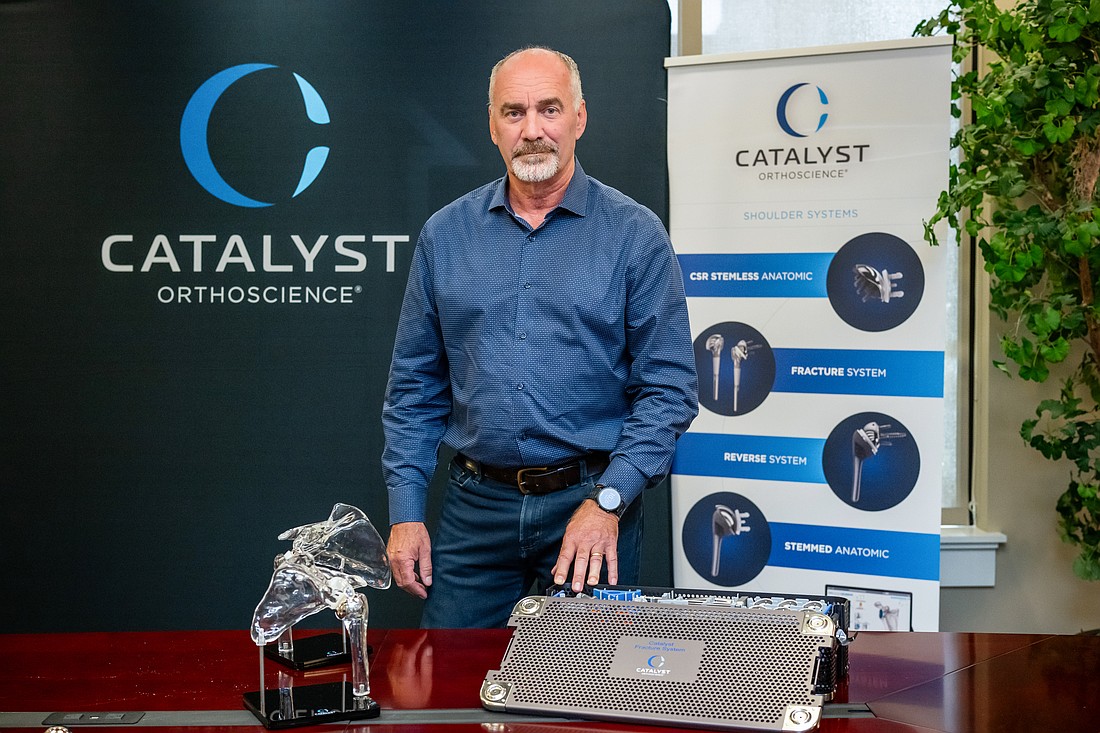
It wasn’t long ago that hips and knees were not replaced but fused, the bones of two joints joined together at the ends, parts of the body often unable to fully bend because this was the best standard of care.
As science developed, a hip or knee replacement meant doctors could actually insert an artificial joint, usually consisting of metal, ceramic and hard plastic, into the area. That made for a more seamless recovery and, ultimately, a more flexible joint. But while hip and knee replacements have become almost commonplace, with hundreds of thousands completed annually, shoulder replacements are a less researched frontier some medical professionals say are a prime opportunity for innovation.
In 2014, Naples-based orthopedic surgeon Dr. Steven Goldberg saw that gap and founded Catalyst OrthoScience, a shoulder replacement medical technology company. In the years since, the company has created six products with U.S. FDA clearance and received multiple votes of confidence from external investors in equity and debt financing, including $15 million last year and $20 million in 2024. In a recent interview, CEO and president Carl O’Connell says the team, in total, has raised more than $50 million.
Much of this funding has gone toward product development, commercial infrastructure and sales, educating surgeons on Catalyst’s products and, of course, regulatory costs, O’Connell adds. In the next few years, company leaders seek to balance the push to grow and scale with the eventual end goal of becoming profitable.
“There are very, very few orthopedic companies underneath $100 million that are profitable,” O’Connell says. “We are in line of sight of being profitable, which is a great thing, but profitability is not a focus. It’s more building and scaling so we can get to that point where we can support ourselves, but we’re not quite there yet.”
And while scaling is the principal focus over profitability, at least in the immediate future, O’Connell says the key to hitting that next major goal is simple: clearly differentiating Catalyst from its competitors.
“We’re trying to do all the right things, trying to make sure we can get to profitability, create value and do things that are different in the marketplace,” O’Connell says, “because it’s pretty much a lot of products that do the same kind of thing and we’re trying to do things a little differently.”
What Catalyst leaders are trying to capitalize on is timing — it’s early in the shoulder market — and knowledge — start with surgeons instead of hospitals. A large part of their work requires informing surgeons about how Catalyst’s various shoulder replacement products function.
“When patients hear that I can move my shoulder back here or behind my back and this product helps me get there, that gets attention. But that takes a lot of money to do,” O’Connell says. “...Most of this has to do with surgeons saying it’s an easier product, more predictable, and you’re going to get great outcomes.”
Where Catalyst tries to set itself apart philosophically is through personal attention toward the surgeons themselves. Even O’Connell goes into operating rooms to really understand surgeon feedback. That’s not a common occurrence for most medical device companies, he says, but Catalyst is small enough that it can make tweaks to products based on real-time response.
Product-wise, Catalyst’s trademark is its streamlined single-tray system, which allows surgeons to use only one tray for their various surgical instruments during a replacement procedure. The company’s implants and instruments streamline the surgical process itself, shaving it down by at least 10 steps on average and sometimes as many as 37 fewer steps. The single-tray method also leads to cost-savings, as much as between $900 to $2,100 per case, given it reduces the amount of sterilization necessary post-surgery.
Orthopedic surgeons, including Connecticut-based Dr. Theodore Blaine, a professor of orthopedics at Weill Cornell Medical College, sit on the company’s board. To Blaine, it is Catalyst’s commitment to constant innovation that makes it stand out.
One of the company’s trademark products is the Catalyst CSR Total Shoulder System — while the standard replacement might be sphere-shaped, Catalyst’s is shaped instead like an egg, more directly replicating human anatomy.
“It’s very different from any other product that’s out there trying to reproduce the anatomy, and the way it was designed using this aspherical implant is that it works better,” Blaine says. “In five-to-eight-year results, these implants are staying intact and performing well. It’s sort of stood the test of time.”
The vast majority of patients who seek a shoulder replacement fall into a few categories, according to Blaine. They either have worn-out cartilage from arthritis, rotator cuff or tendon tears that make it hard to raise their arm, fractures or even revision shoulder replacements for procedures that didn’t go well the first time. The success of these implants is generally evaluated through self-reported patient satisfaction, function and range of motion, i.e. how easily the patient can raise their arm, and survival of the implant. Across most of these factors, Catalyst has scored well, Blaine says.
“They are in a very rapid growth phase right now — it always takes a while for new products to be adopted by surgeons. Now it has been adopted by surgeons and it’s a rapidly growing company,” Blaine says. “More patients need these prostheses. It’s a fast-growing market and Catalyst is right there with it.”
Goldberg founded Catalyst OrthoScience in 2014 in part out of a desire to start a medical technology company from the point of view of a surgeon, not a patient or an administrator. That’s ultimately been to Catalyst’s benefit, according to O’Connell.
“In so many ways, it’s like designing a car,” O’Connell says. “It’s not from our perspective, it’s from a driver’s perspective. So we’re able to design products that surgeons really want.”
Since the company’s first case in 2016, more than 18,000 procedures have been completed using Catalyst’s products. And in a midterm paper published last year in the Journal of Shoulder and Elbow Surgery by Goldberg, a retrospective study of more than 200 patients using Catalyst’s products showed that roughly 77% of patients reported an evaluation score of 95.
“That’s highly unusual,” O’Connell says. “So that speaks to the design and the ability of the surgeons to be able to use the product effectively. So we’re doing that with all our products. Not only are we designing products based on what we hear and feedback, but clinically supporting them and getting that sort of feedback is critical.”
Now, the focus is on growing and on continuing to create products that surgeons and patients will want to use. The next step in this process is Patient Specific Instrumentation, a computer-assisted operative technique that uses software to create a 3D model of the anatomy and the instruments before the operation itself to ensure a better operative experience. Catalyst’s own PSI-paired guide, Archer, received FDA 510(k) clearance this February and is now in a limited user release, with over 70 completed cases.
At the same time, the “where” of shoulder replacements is changing, and O’Connell estimates that, within the next five to 10 years, roughly 50% to 60% of shoulder procedures will take place in ambulatory surgery centers instead of hospitals. This is already starting to create changes in the dynamics between healthcare providers and companies like Catalyst.
“When you move to the ambulatory surgery center, then automatically people try and negotiate with lower pricing and additional products,” O’Connell says. “Some of the big companies are able to offer different things, like hips and knees and surgical beds, and we’re just pure play shoulder, so we’re trying to maintain our value.”


