Sarasota County bans data center applications for one year


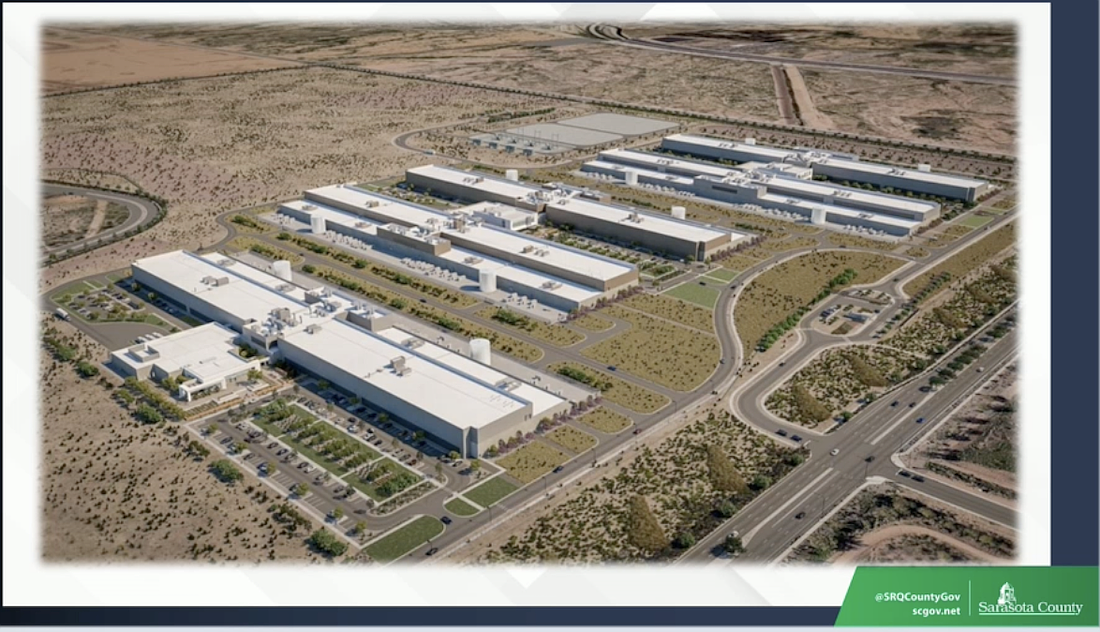
Sarasota County Assistant Director of Planning and Zoning Michele Norton presented this picture as an example of what a hyperscale data center looks like.
Image courtesy of Sarasota County
  • Manatee-Sarasota
  • Share

Sarasota County commissioners, by a 5-0 vote, approved a one-year moratorium on the acceptance or review of data center applications. 

Commissioners passed the 12-month ban at their Wednesday meeting. The pause will enable county staff time to evaluate how these developments — massive structures designed to provide power to meet the AI-fueled increase in energy demand — fit into the jurisdiction's zoning code. The discussion and vote happened even though the county has yet to receive any official data center applications. 

“There's a difference to me between saying whether you're open for business or you're not open for business,” Commissioner Teresa Mast said. “Saying that you're not accepting applications, I think — that's a very clear direction.”

In passing the yearlong freeze, the county joins several others around the state that have placed moratoriums on data center development. Among them are Citrus, Nassau and Hernando counties, according to Sarasota County Assistant Director of Planning and Zoning Michele Norton. Dozens of other jurisdictions across Florida have also been discussing the projects and a potential response. 

While there have been no formal applications, “Sarasota County has recently been approached by a company expressing interest in property along Cattleman Road for a data center,” according to a planning and zoning staff report provided to commissioners.

Norton gave a presentation on hyperscale data centers during the board’s meeting, explaining that the facilities — filled with servers, networking equipment, storage systems, cooling systems and power infrastructure — can range from 100,000 to more than 1 million square feet.

“The large-scale data centers have an extreme continuous electrical load demand on our grid,” Norton said. A 50-megawatt center can consume the power equivalent to 35,000 to 50,000 homes, she noted, while one in Loudoun County, Virginia, used more than 4 gigawatts in 2024.

In addition to power, data centers use water for cooling purposes so that equipment does not overheat. Smaller facilities use about 52,000 gallons of water per day, Norton said, while larger AI data center campuses can use up to 5 million gallons of water daily. Sarasota County's Carlton Water Treatment plant, one of several sources the county relies on for water, provides 8 million gallons of treated drinking water a day to residents and businesses.

As companies look to build new data centers, Norton noted several jurisdictions around the state have put data center moratoriums in place to allow time for review of codes and potential impacts.

“We do not believe that this [data centers] is a permitted use, but staff needs to perform what I would call a deeper dive into the comp plan and the rest of the code, just to make sure that this position holds,” Norton said. “We do have a data processing center [that] is allowed in our UDC [Unified Development Code] as under the office use.”

Commission Vice Chair Mark Smith encouraged staff to make clear the county’s position through its code.

“My idea would be to direct staff to figure out what we need to put in our codes to make sure they can't apply,” Smith said, “so that anybody who’s thinking about it coming here need not enter.”

He said he did not think this was the right location for such facilities.

“They don't belong in Sarasota County,” Smith said, noting “the hum of these things, the size of them. They're lit up like prisons because of security reasons at night.’

Commissioner Joe Neunder added that Sarasota County was not the right spot for data centers due to resource concerns.

“The large consumption of electricity and the draining of our power grid” is a “huge red flag,” Neunder said, later adding water is another concern. “Not to mention the possibility of negative impacts to our very delicate ecosystem and environment.”

Regardless of the findings related to the zoning code, “Ultimately, at the end of the day, for me, it's no, not now, never," said Neunder, who is running for reelection, starting with the Republican primary next month against Jim DeNiro. "I don't see this as ever being something from one person's perspective that we would ever want in our community.”


author

Elizabeth King

Elizabeth is a business news reporter with the Business Observer, covering primarily Sarasota-Bradenton, in addition to other parts of the region. A graduate of Johns Hopkins University, she previously covered hyperlocal news in Maryland for Patch for 12 years. Now she lives in Sarasota County.

Latest News

Sponsored Content