- November 6, 2025
Loading
The new owners of the Tampa Bay Rays have made building a new stadium in the region by Opening Day 2029 a priority and have begun looking at potential sites.
The ballpark, Patrick Zalupski, the new managing partner and co-chair of the Rays said at an introductory news conference Tuesday, would anchor a 100-acre development with hotels, office, retail, bars and a music venue. The stadium would have a closed roof and it would host as many as 180 events a year.
“This list of criteria is effectively everything we believe to be essential to delivering a world class live, work, play experience,” Zalupski said.
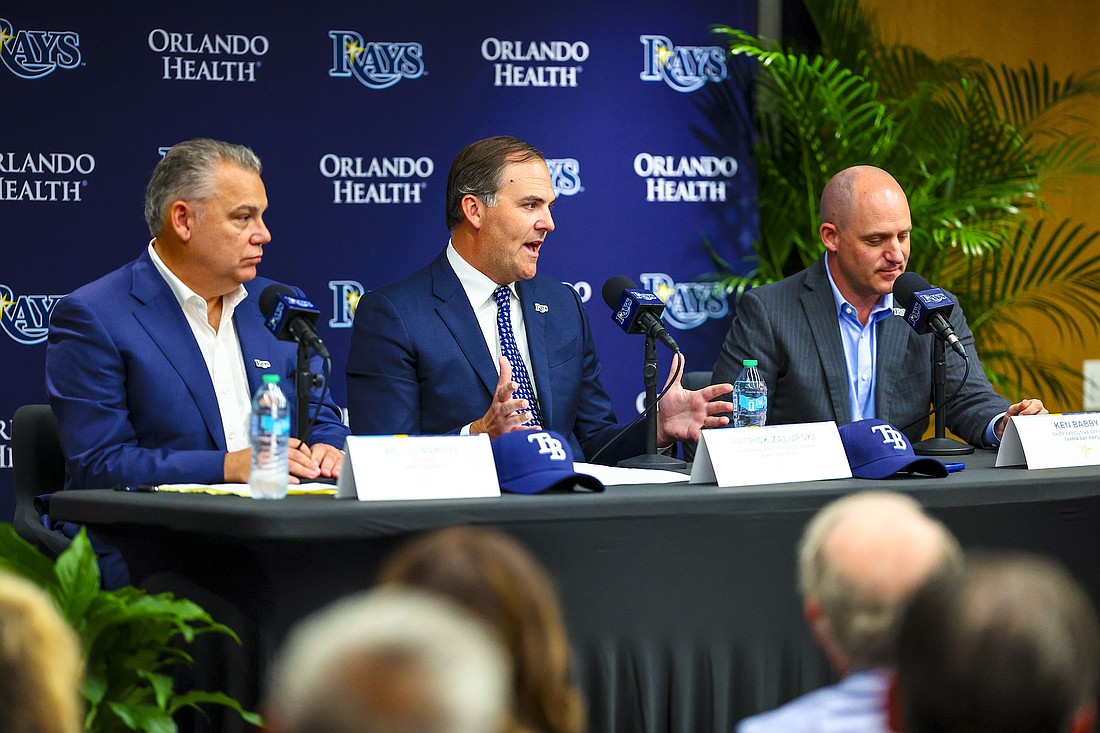
Zalupski, who leads the ownership group that has bought the Rays, met with the media Tuesday before heading out to meet with team employees. The press conference, held at George Steinbrenner Field in Tampa, where the team played this season, was a chance for Zalupski, new team CEO Ken Babby and team co-chair Bill Cosgrove to talk publicly about their vision for the organization.

Not surprisingly, the conversation — from the opening statements to questions —mostly centered on the need for a new ballpark and the development it plans to build.
If Zalupski's plan sounds familiar, it should.
Zalupski, the Jacksonville homebuilder, and the ownership group. have inherited an all-too-recognizable dilemma to those who have followed the organization for the past two decades. If the team is to thrive, it must move out of its existing home at Tropicana Field and into a facility that can produce the type of revenue to build a sustainable organization that’s competitive on the field for the long term.
And that facility has to include more than a stadium.
“We think without that revenue generation, it's really challenging or nearly impossible to compete with the major markets,” Zalupski said. "So, for us, this is critical to building a championship team.”
The challenge to building a ballpark for years has been where to build it and how to raise the money for it. The previous ownership tried for years, coming to the point where it announced plans at least twice, before those deals fell apart. There was even talk of relocating the team.
The new owners, though, believe they can do what the previous regime was unable to.
To that end, the group has begun looking at potential sites both on the Hillsborough County and Pinellas County sides of Tampa Bay and is considering all its options. It has also begun discussions with local officials, which it was contractually prohibited from doing until the deal closed Sept. 30.
Zalupski said the main criteria is finding a property with enough land to develop a substantial multi-use development and to balance that with the quality of the location. “There’s a point where that will all intersect.”
The ownership group is looking at The Battery Atlanta as a model and has had conversations with the owners of the Atlanta Braves. The Battery is a mixed-use development adjacent to Truist Park, where the Braves play. It is in suburban Atlanta and includes retail, dining, entertainment, residential and office space.
“We’re now full steam ahead on site evaluation, feasibility, analysis,” Zalupski said. “There's more sites to meet the criteria than you would realize.”
The ownership, though, acknowledged the process has been difficult in past years and committed to bringing more transparency. What it didn’t say was how the development would be paid for — only that it would be a public-private partnership.
“We're very aware and in touch with the fatigue around this issue over the last 21 years,” said Babby, who is overseeing day-to-day operations of the organization.

“We certainly haven't lived it firsthand, but being alongside the staff, understanding and listening — so much of this is about listening and asking questions — we know that fatigue is real, and we have a lot of work to do ahead of us, and that work begins today.”
Zalupski said given the fatigue Babby described, the organization has a responsibility to lay out its vision to the community and form partnerships — working together rather than making demands.
“We've got to provide economic reports and studies and work together with the counties, with municipalities, the cities, to come up with the best cohesive development we can generate together,” he said.
In a sign that there is political will to make a stadium work locally, St. Petersburg Mayor Kenneth Welch and Tampa Mayor Jane Castor were in the front row of the news conference.
Welch said afterward that despite the Rays’ agreement to build a new ballpark and redevelop the Historic Gas Plant District publicly blowing up earlier this year, the political will still exists to make a new ballpark work in the city.
Though, he was quick to add, the focus now is on a new $6.5 billion proposal to redevelop the Gas Plant District, the historically Black neighborhood razed to build Tropicana Field.
“The Rays need to be in Tampa Bay,” Welch said.
“We've been counted out before in the city of St Pete. We know what our assets are. We know who our partners are in the county. But we also know that we have other interests and so we're going to move forward in the best interest of the citizens of the city St Petersburg.”
While much of the focus Tuesday was on the new ballpark, the ownership group also discussed moving back into Tropicana Field in time for next season.
Babby said that the team will announce a number of new fan experiences early next year and that in addition to the new roof, there will be new video boards and a sound system.

And the ownership said it is committed to creating a team that can contend for — and win — a championship.
“We understand that it's all about winning on the field, winning in the community, and that's what we intend to do,” said Cosgrove, CEO of Ohio-based Union Home Mortgage.
As part of the commitment to winning, the ownership group says there is a self-imposed rule in place where none of the owners or partners are allowed to talk to — or interfere with — the baseball operations side of the team.
Instead, the ownership’s focus will be on building up the organization. And the first step to making that possible, said Zalupski, is a “new forever home to secure the Ray's long-term future in Tampa Bay.”
“Delivering upon that objective will be our first priority.”