- December 13, 2025

-
-
Loading
Loading
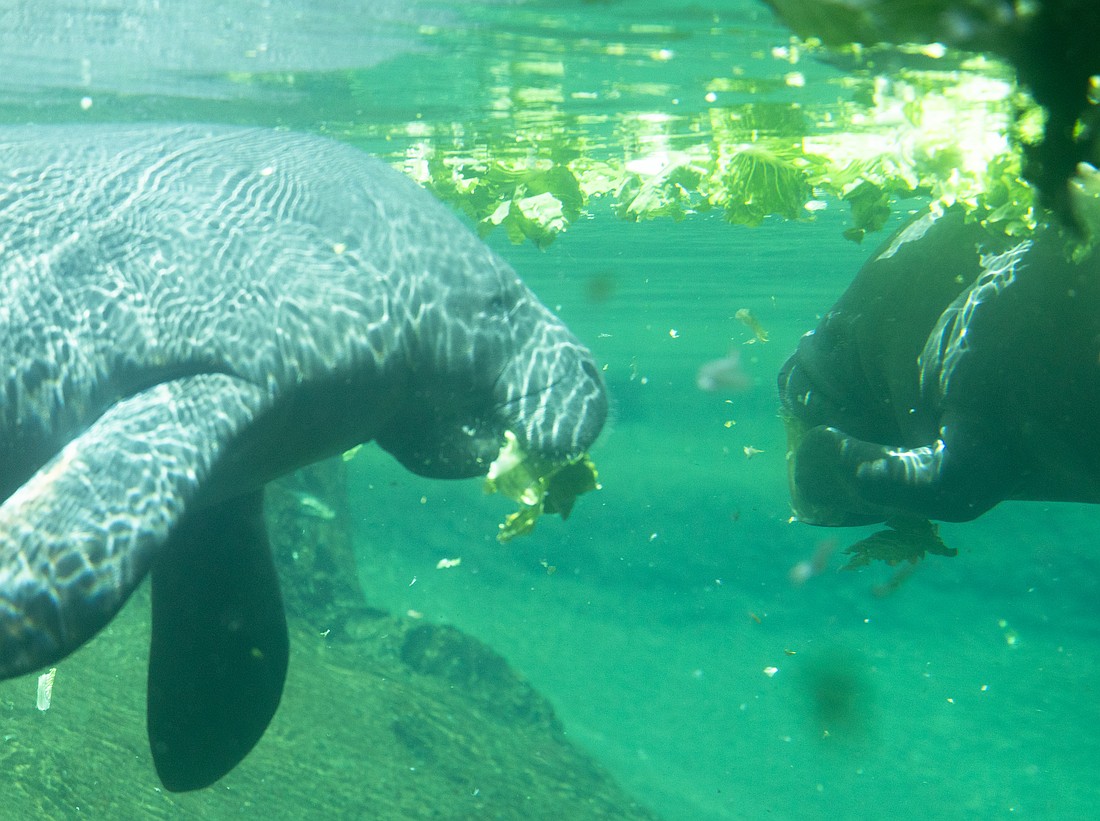
The 10-year-old manatee spends her days drifting across the surface of the water, munching lettuce leaves with her whisker-covered snout while her two-year-old calf swims figure-8s between her flippers in the shallow, concrete pool. It’s a lazy, listless life, but one that staff at ZooTampa at Lowry Park are working tirelessly to save.
The mother and child, whom staff named Venti and calf-acino, were in critical condition when they were taken to the David A. Straz Jr. Manatee Critical Care Center several months ago. Venti bobs along the surface because multiple tears in her lungs cause her chest cavity to inflate, likely due to serious watercraft injury, staff say.
Fortunately, though, Venti and calf-accino were rescued just as ZooTampa nears the completion of a major renovation to its Manatee Critical Care Center — the largest nonprofit center of its kind in the world. It is also now one of only two places nationwide that can take in critically injured or sick manatees and orphaned calves, the other being Seaworld in Orlando.
It’s the largest expansion project ZooTampa has ever taken on and one six years in the making. Once completed, likely in March 2026, the Straz Manatee Rescue Center — a $35 million project — will feature a completely redesigned Manatee Tunnel building, offering visitors eye-level, underwater viewing of the manatees along with tanks full of reef fish from the Florida Keys, native Florida gamefish and Moon jellyfish, as well as a manatee overlook. The expansion also includes an adjacent riverbank otter enclosure, as well as a reptile and amphibian discovery center.
The zoo has already completed the installation of two new critical care pools, which brings the total number of tanks for orphaned calves and manatees undergoing medical treatment to five. That’s where Venti and calf-accino are being held until her condition stabilizes and she begins to put on weight. Once the manatees reach 600 pounds and are deemed medically stable, they will be relocated to the newly-designed viewing pool until the Florida Fish and Wildlife Conservation Commission clears them to be reintroduced into Florida’s coastal waters and rivers.
“Venti is a perfect example of why we do what we do,” says Molly Lippincott, the zoo’s senior curator of Florida and marine life. “She is so severely injured and yet she hasn’t given up, she continues to eat and swim and nurse her calf and seeing her resiliency is really what keeps all of us so dedicated to this mission. Fortunately, this center allows us to do everything we can to save them until we can’t.”
Once completed, the center will make up a section of the zoo dubbed “Florida Waters.” A fundraising campaign for the project has already raised roughly $35 million, says Chief External Relations Officer Mark Haney. The initiative netted two record-breaking private donations to the zoo, one of which came from the Straz family, staff say. They declined to disclose the amounts.
The David A. Straz, Jr. Manatee Critical Care Center has been a fan favorite at the zoo ever since it opened in 1991.
But, it’s not a money maker, Haney says. Instead it operates at a loss. But with fewer facilities capable of caring for Florida’s growing number of injured, malnourished or extreme stress due to cold exposure, operating the preeminent care center in the world is a point of pride for ZooTampa.
When the zoo’s manatee rescue first opened, state officials estimated that Florida was home to 4,000 manatees. Now, that number has grown to an estimated 8,000 to 10,000.
ZooTampa has treated and released 614 manatees back into Florida’s waters, and currently has 17 in its care. Last year alone the zoo treated and released 28 manatees — the most in its 34-year history. That figure is primed to grow with the newly revamped Manatee Rescue Center.
“We have to believe we make a difference, and when you see the kids come in each day and ask questions about the manatees I truly think we are making a real difference,” Lippincott says.