Putting on college football's championship is a four-year game

Tampa will host the 2029 College Football Playoff's national championship game in 2029, but its a world away from a Super Bowl.


  • By Louis Llovio
  • | 5:00 a.m. November 5, 2025
  • | 2 Free Articles Remaining!
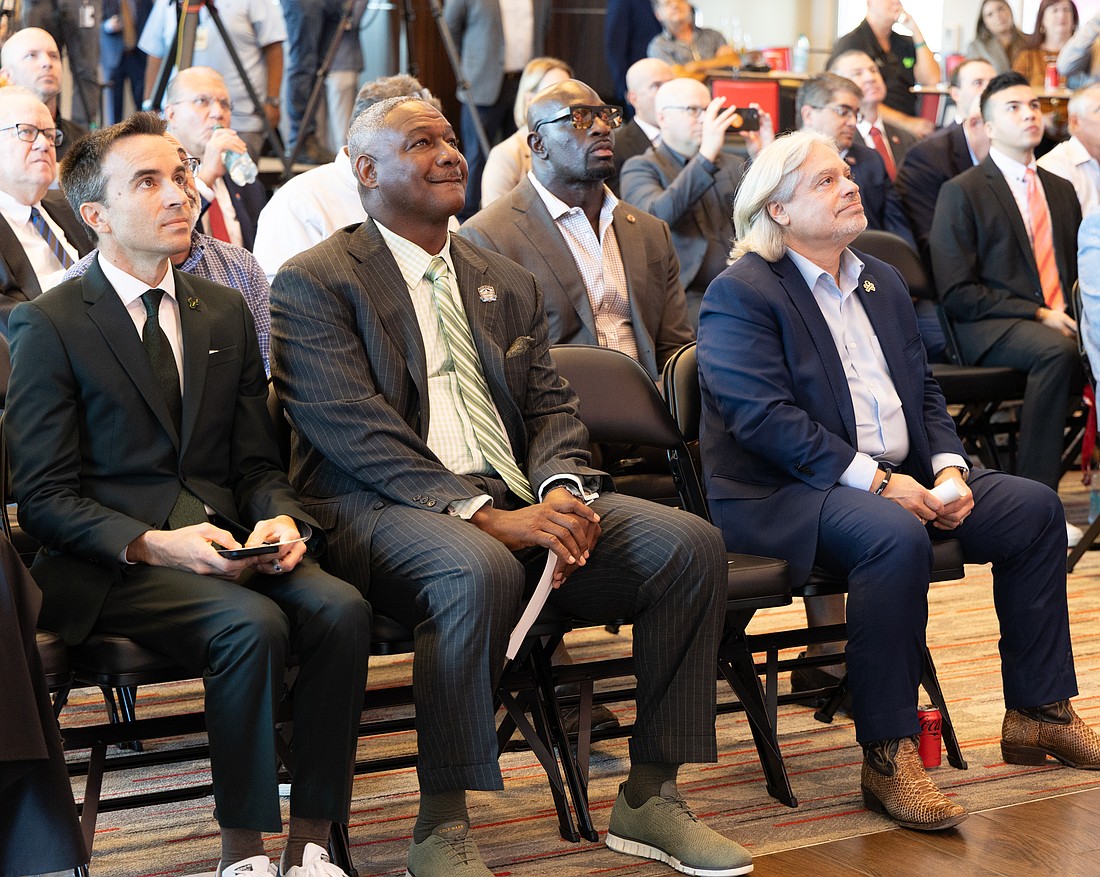
Rob Higgins, CEO of USF Athletics, Derrick Brooks, former Tampa Bay Buccaneer and NFL and college football Hall of Famer, and Santiago Corrada, CEO, Visit Tampa Bay watch a presentation on the 2029 CFP championship game coming to Tampa. Titus O’Neil, a retired professional wrestler and college football player at the University of Florida looks on from the second row.
Photo by Mark Wemple
  • Tampa Bay-Lakeland
  • Share

On a Tuesday morning in late October, a group of prominent Tampa leaders gathered in front of the media at Raymond James Stadium to make an announcement.

This group of local heavyweights ranged from the city’s mayor, to a Tampa Bay Buccaneer legend and Hall of Famer, to a professional wrestler. The mood, as it often is with these folks when they gather with cameras around, was buoyant.

They were at the stadium to announce that Tampa would host College Football Playoff’s national championship game Jan. 22, 2029. This is the second time the sport’s ultimate game will be played in the city. The last time was in 2017, when Clemson beat Alabama 35-31 in front of an overflow crowd of 74,512 fans, according to Visit Tampa Bay.

How well the city did with the previous game was cited as one of the reasons for Tampa getting to host it a second time. But one of the other reasons, and this one was repeated often by the day’s presenters, was its success hosting Super Bowls.

“If a city can host a Super Bowl, they can certainly host a college playoff championship game,” says Rich Clark, the executive director of the organization charged with putting on the event.

“It gives us an idea of how the city executes and how they do it, and how smooth it goes. Things like that.”

Clark says when looking for where to place a game, the organization also looks at its infrastructure, the relationships between the groups that will be needed to work together to pull it off and a city’s ability to put on big events.


Super sell

Tampa has now established itself as the kind of city capable of handling the biggest events, from the Women’s NCAA Final Four this past April to political conventions. But its defining accomplishment is Super Bowls — five of which have been played in the city since 1984, when the Los Angeles Raiders beat the Washington Redskins 38-9. 

Rich Clark is executive director of the College Football Playoff.
Photo by Mark Wemple

Only New Orleans (7) and Miami (6) have hosted more since then.

Yet, while playing the same sport on the same field with the same basic rules, comparing the Super Bowl to the national championship game is like comparing apples to carburetors.

“The Super Bowl is one of the biggest events in the world. We're not there,” says Clark.

The biggest difference between the two games is the scale.

The Super Bowl has grown over the decades to become an international holiday of sorts that regularly draws more than a billion television viewers.

A sign of just how powerful a force it is, is how much companies are willing to pay to advertise during the game. The industry publication AdWeek reported in July that NBCUniversal, the network airing the Super Bowl Feb. 8, is charging $8 million for a 30-second spot. TVRev, another industry publication, reported that a 30-second commercial during the college football championship game earlier this year sold for between $1.4 million and $2 million.

But the differences between the National Football League’s game and CFP’s game isn’t just monetary or about scale. It changes how the event is put on, says Eric Hart. CEO of the Tampa Sports Authority, which manages Raymond James Stadium.

The Super Bowl has moved to a model where the NFL pretty much takes over and runs the event. They decide everything that happens and controls every aspect of the weeklong event. The authority, in essence, hands over the keys to the building he says.

“CFP typically does not work that way. Now, maybe their model will change, but normally what will happen is they’ll give you the guidelines and they want you to take care of them…CFP is a little bit more laid back.”

As part of the process, Raymond James will undergo a massive makeover ahead of the game. A brand-new field will be installed, there will be painting, and the building will be fully converted with all the Buccaneers signage taken down on the outside and replaced with CFP and team logos. “We'll do a full transformation,” he says. “People won’t sleep that month.”

There is one scenario, though, where the NFL could interfere with the planning at the stadium in 2029. If the Buccaneers make to the NFC Championship and get a home game that season, the prep work would have to be put on hold.

“There is a potential crossover that we have to work with the NFL,” he says. “If we make it to the NFC Championship, it makes this a lot harder.”

But putting on a Super Bowl and a CFP championship aren’t all that different for every organization in the city.


The road to victory

“They're not as dissimilar as you might think,” says Santiago Corrada, CEO of Visit Tampa Bay.

Santiago Corrada is CEO of Visit Tampa Bay.
Photo by Mark Wemple

Over the next few years, it will work with the Tampa Bay Sports Commission and other organizers on familiarization visits and logistics. And it will work with local hotels, the airport and others to make sure who needs to be engaged is engaged.

“There's a lot that goes into these events,” says Corrada. “We all come together to make these announcements, but the work that's gone in — months and years before — and then years until the event actually happens is pretty dramatic. People don't really get the magnitude of that.”

If all goes as planned over the next four years, the Oct. 28 ceremonial victory lap will be the one opportunity for the public to hear about the effort that goes into the event. The rest of the time, all that will matter is who gets plays in the 2029 football game — and who wins it.

And when it comes to that, the CFP national championship and the Super Bowl are no different.


author

Louis Llovio

Louis Llovio is the deputy managing editor at the Business Observer. Before going to work at the Observer, the longtime business writer worked at the Richmond Times-Dispatch, Maryland Daily Record and for the Baltimore Sun Media Group. He lives in Tampa.

Latest News

Sponsored Content