Sunshine Ace Hardware goes big on brick-and-mortar strategy

The Naples hardware store chain's chase for customers revolves around removing obstacles for customers and the action inside the store, not in a web browser or app. The strategy is working.


  • By Mark Gordon
  • | 5:00 a.m. July 10, 2025
  • | 2 Free Articles Remaining!
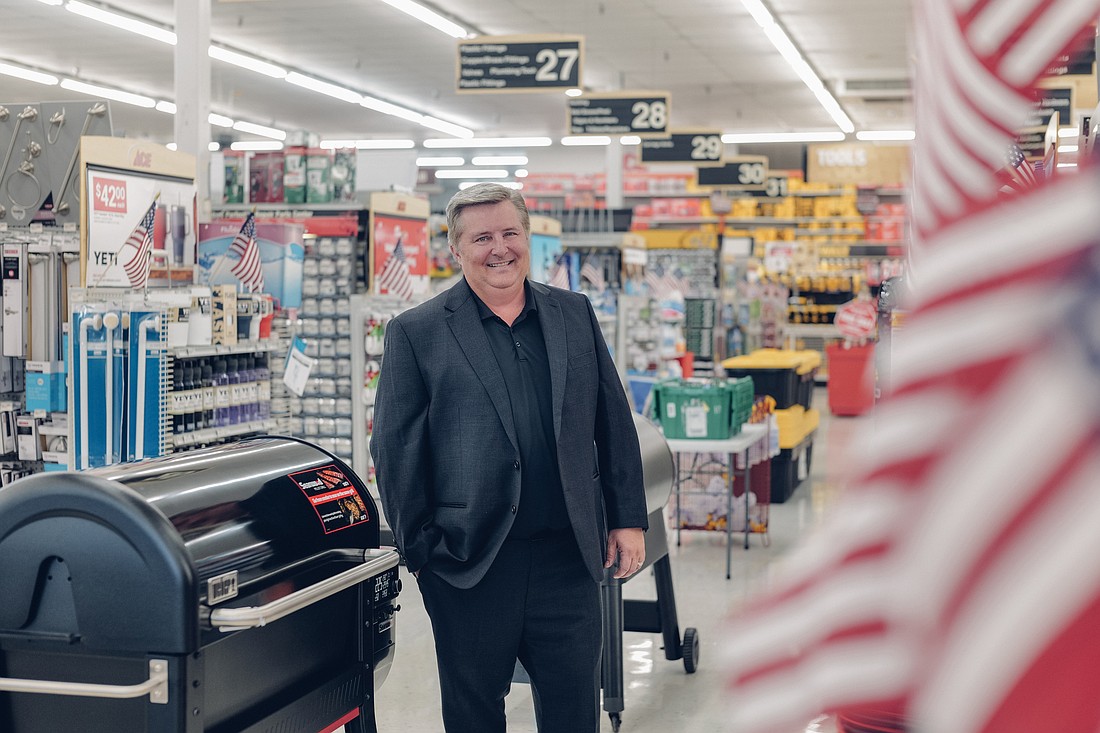
Sunshine President Michael Wynn says product mix helps fuel the company's in-store sales strategy.
Photo by Reagan Rule
  • Charlotte–Lee–Collier
  • Share

The e-commerce monster, which has been gobbling up brick-and-mortar stores and shopping centers for years now, has not devoured Sunshine Ace Hardware. Yet. 

The Naples-based chain, while not totally discarding e-commerce at AceHardware.com, is a big believer in actual stores driving sales. So much so the family-run company is opening three new physical stores in 2025 alone. One opened in Babcock Ranch, the solar-powered master-planned community that straddles Lee and Charlotte counties, May 1. Another, in the Winchester Center near Golden Gate Estates in Naples, had a soft opening the first week of July. And one more, in the Marketplace at Pelican Bay in North Naples, is scheduled to open this fall. 

Sunshine President Michael Wynn, a Business Observer Top Entrepreneur in 2019, says while going all-in on stores has its risks, the opportunities and competitive advantages in the strategy are even better. He’s considering opening another store in Collier County in 2026, and is scouting sites up and down Florida’s west coast for more possible stores. 

The company, with some 570 employees, operates 14 Ace Hardware locations and two Benjamin Moore paint and decorating stores, spread from Naples to Largo in Pinellas County. And when the two new stores open, it will have added or purchased six locations since April 2023. Current annualized revenue companywide, says Wynn, exceeds $100 million. E-commerce makes up less than 10% of that total, while the rest is in-store and the company’s omni-channel options.

“There’s a lot of pressure on retailers right now,” Wynn says. “Insurance rates, property rates, property taxes — all of these elements put a lot of pressure on margins for retailers. But we're moving forward with our growth strategy and that’s not going to change. I’m very bullish on Florida.”


An old tale

Chris Jones, a professor of economics at the University of South Florida and president and chief economist of Florida Economic Advisors in Tampa, says Sunshine Ace is on the right track with its strategy. “Brick-and-mortar is all driven by (being in) neighborhood and community centers,” he says, which is where Sunshine Ace gravitates toward. 

Jones adds that the smaller community-centric centers, which tend to have higher customer service-oriented stores, are doing significantly better than larger regional centers or malls in foot traffic and sales.

Sunshine President Michael Wynn was a Business Observer Top Entrepreneur in 2019.
Photo by Reagan Rule

On a national scale, e-commerce remains, in some ways, the little brother to in-store shopping, so Sunshine’s strategy makes sense in that way, too. To wit: 84.6% of all shopping was done in-store in 2024, while 15.4% was conducted online, according to research firm BusinessDasher. 

But that’s not the way the trendlines are going: that same report found that since 2011, online sales have increased 300% against a 50% decrease in department store sales. In addition, the number of physical stores have declined from 450,000 in 2011 to just under 350,000 in 2021 — a -22% drop, BusinessDasher found. 

Another report, from Fit Small Business, found that major retailers closed 4,913 stores in 2023, up 28.6% over 2022. A chunk of the retail closures, in and out of the reports, stem from retail chain bankruptcies. A partial list of recent retail bankruptcies includes Big Lots, Jo-Ann Stores, Conn’s, The Container Store and auto parts retailer Parts ID.

E-commerce stats like those don’t seem to faze Wynn. Founded in 1958 by his grandfather, Don Wynn, Sunshine Ace Hardware is now among Florida’s largest family-owned home improvement retailers. In addition, out of 2,603 Ace dealers nationwide, Sunshine is one of the 10 largest volume domestic purchasers from the parent corporation.

One reason the company believes in its brick-and-mortar strategy is inside the stores, Wynn believes, is where the company can differentiate itself from competitors. It has well-trained personnel in red vests walking and working the stores, realizing oftentimes do-it-yourselfers don’t know exactly what they need. Also, its in-store philosophy has tentacles, including in-store pickup, curbside pickup, direct to home delivery and even a drive-thru window at one location. Sunshine, says Wynn, also offers in-home services many competitors avoid, such as handyman services and numerous repairs and maintenance tasks. 

Jones, citing specifically the handyman and repair services, says the high-touch customer service approach makes a big difference. “The Home Depots and Lowes are large volume retailers,” he says, where Ace can compete with "creating a customer service relationship.”


Home work

Wynn says there are two ways the company approaches its store selection philosophy. One is to go with a new build. The benefit there is to create your own space and design from scratch. The flip side? A new build is usually more expensive, especially up front, than the other way, which is retrofitting an existing building that belonged to another brand. The company owns about half its stores, Wynn says, and rents the other half. 

A Sunshine Ace store opened in July in the Winchester Center in Naples.
Courtesy image

Sunshine is utilizing both methods in Collier County. With the Winchester store, it’s building from the ground up in partnership with developer Barron Collier Cos. That project, Wynn says, is costing at least $9 million — an investment he emphasizes is for the future, looking out 10 years. “You have to try and pencil it out and see if it’s going to be worth it and hold long-term value,” he says. “We take a long-term view.”

Some 15 miles away, the company is opening a Sunshine Ace store in part of a former SteinMart store in Pelican Bay. It’s taking 21,000 square feet of what was a 35,000-square-foot department store. Most of the company’s stores are in the 20,000 square foot range. And like building a new spot, this strategy, Wynn says, is research-heavy. Good sites are hard to find, he says, so “you have to be doing a lot more homework in site selection on sales projections because you’ll be paying higher rents, so you have to increase your margins.”

Whether it's a new build or an old store retrofit, a key part of the strategy, says Wynn, is to put stores in geographic clusters. This helps with spreading around marketing and advertising dollars, he says, adding that the “more density we have the less opportunity there is for our competitors to come into the market.” 

Wynn says Sunshine’s real estate team meets quarterly with Ace’s corporate team to research sites. And Wynn, a philanthropic and civic leader in and around Naples, is regularly networking with developers and others in the region to stay on top of potential sites. On that, relationships matter. Wynn cites Barron Collier Cos., where Sunshine Ace is a preferred client. “They know we are a good risk and a good tenant,” he says, “and they know the types of places we want to be.”

Once inside the stores, the strategy is to focus on customer ease, or, as Wynn says, “when competing with the ease of online ordering the task for Sunshine is to remove friction for our customers.” 

A get to yes customer service ethos is one way the firm does that. (One of the company’s core values is to “create solutions through imagination,” where employees, according to the company’s website, are encouraged to “respond to every situation by looking for how we can do it, rather than explaining why it can’t be done.” Deliver sunshine is another core value.)

A lesson the company has learned in getting to yes, says Wynn, is in product mix. So while some stores sell a lot of fishing and tackle gear, others don’t. “We’ve expanded our product mix to be as diverse as possible,” he says. “You don’t want to be too dominant in any one category.”

Outside product mix and site selection, Wynn has some big picture worries — namely, the cost of housing and general cost of living in Florida and the impact that has on customers, and employees. He also brings his focus to things he has a greater control over. “Our business thrives on being convenient and helpful for customers,” he says. “We need to keep doing that.”


author

Mark Gordon

Mark Gordon is the managing editor of the Business Observer. He has worked for the Business Observer since 2005. He previously worked for newspapers and magazines in upstate New York, suburban Philadelphia and Jacksonville.

Latest News

Sponsored Content