- March 12, 2026

-
-
Loading
Loading
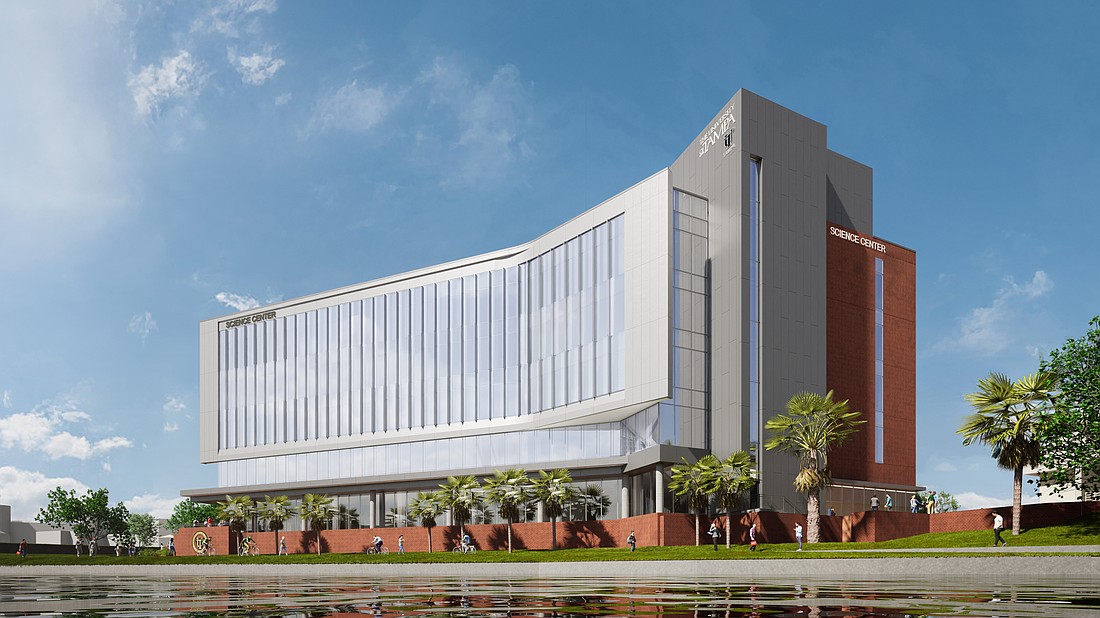
Construction is scheduled to begin this spring on a new landmark science center on the University of Tampa’s downtown riverfront campus, the university announced Monday.
It’s the largest academic facility investment in the university’s 94-year history, according to a release, and designs include cutting-edge facilities that promise to support UTampa’s growing prominence in science education and research. UTampa officials declined to disclose a total cost estimate for the project.
The new Science Center, scheduled to open in spring 2029, will be a sprawling five-story, 153,000-square-foot building along the Hillsborough River that serves as the academic nerve center for the College of Natural Health and Sciences.
The sleek, modern building will feature state-of-the-art teaching and research laboratories intended to “foster collaborative, interdisciplinary learning and discovery,” the release says. Specifically, the building will be used by students preparing for careers in high-demand, scientific fields of health care, sustainability and biotechnology entrepreneurship, as well as those taking science-based coursework.
The Science Center’s construction is supported in part by a generational gift from Stephen and Marsha Dickey, although a specific amount has not been disclosed by the university. The Dickeys are longtime benefactors of the university and the namesakes of UTampa’s Dickey Health and Wellness Center, built in 2011. Stephen Dickey is a trustee emeritus for the university and the founder of Tampa-based Doctor’s Walk-In Clinic.
“The design reflects an understanding that science, technology and how we teach and learn will continue to evolve,” Dickey says in the release. “This facility will strengthen the University of Tampa’s ability to attract high-quality students and faculty and will benefit the entire University community.”
The building will be a central hub for cross-disciplinary teaching and research, the release says, providing a central location for science teaching and research that is currently scattered across the campus in myriad locations including Plant Hall and the Jenkins Health and Technology Building.
The Science Center will house the biology, chemistry and biochemistry departments, as well as programs in forensic science, marine science, allied health, computational science, environmental science and other related fields.
All will be housed in a modular, adaptable design that supports evolving scientific research and teaching needs, the release says. That includes 73 faculty offices, 25 teaching laboratories and 23 research laboratories supporting disciplines such as genetics, marine biology, anatomy, microbiology, immunology, molecular and cellular biology, biochemistry, organic and advanced chemistry, forensics and related fields.
“The Science Center is a transformative, forward-facing facility that represents a major step forward for UTampa’s science programs and for the University as a whole,” says University of Tampa Provost and Chief Academic Officer Mike Stephenson in the release. “It will enhance our ability to attract talented students and faculty and provide a collaborative environment where teaching and research can thrive.”
Architecturally, the building will reflect UTampa’s historic character in a modern frame. The west-facing side will feature red brick to complement Plant Hall and the surrounding campus, while the east-facing side will incorporate glass and contemporary angles to maximize unobstructed views of the river and downtown Tampa.
The complex will also include three outdoor spaces: a grand Entrance Plaza, a Riverside Garden adjacent to the West Riverwalk and a Northeast Quadrangle between the Science Center and the Cass Building.
Other key elements of the new Science Center include three microscopy rooms, four aquarium research laboratories, a bioinformatics and computational sciences teaching classroom, two tissue culture laboratories, an advanced instrumentation laboratory and a 35-seat general-use classroom designed for future conversion to a 20-station instructional lab.
HDR Architects is designing the building, with Barr and Barr serving as the construction contractor.