- August 14, 2026
Loading
Nursing student Ariana Sawyer knows that one day, a patient will trust her with their life.
That reality can be intimidating. But inside the University of South Florida’s newly expanded College of Nursing, Sawyer and her classmates now have a place to make mistakes before the consequences become real.
“This simulation center gives us a safe place to make those mistakes, where we can build confidence and grow before someone’s health or life depends on the decisions that we make,” Sawyer said. “That is an incredible gift.”
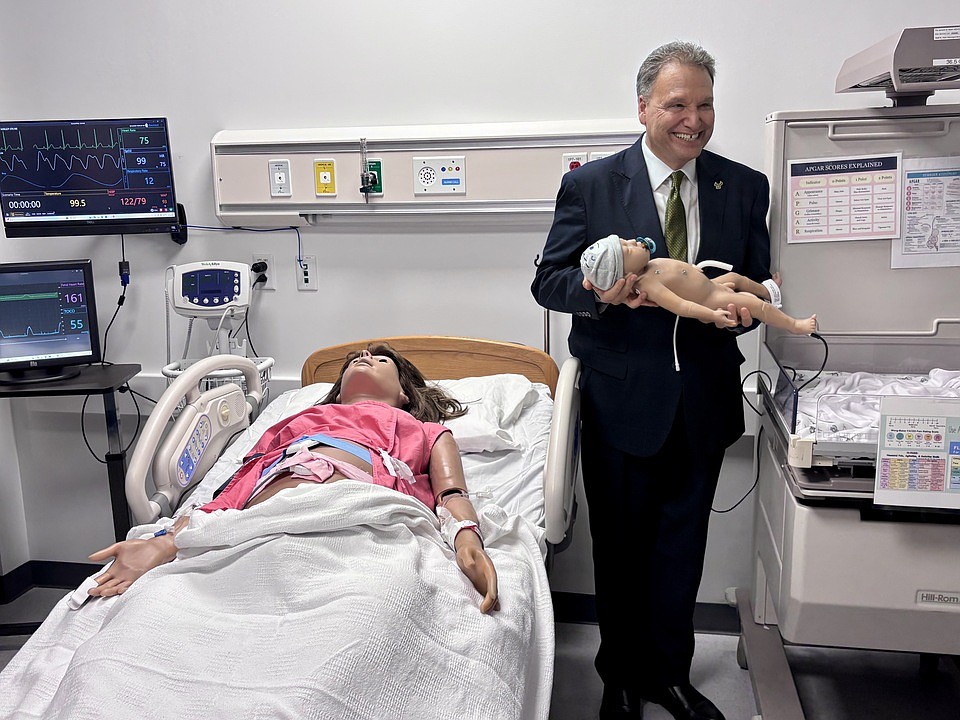
USF officials, along with Sawyer and others, marked the opening of the 42,000-square-foot expansion to the College of Nursing building on the university’s Tampa campus Friday with a ribbon-cutting ceremony. The $33 million project adds classrooms, learning labs and realistic clinical environments intended to help USF train hundreds more nurses as Florida contends with a persistent shortage.
The expansion includes the College of Nursing-Tampa General Hospital Nursing Simulation Center, funded through a $4.4 million investment from Tampa General. It features 12 clinical examination rooms, four learning labs and six high-fidelity simulation rooms with adjoining spaces where students and instructors can review their performance.
The rooms can recreate conditions in hospitals, clinics, community settings and long-term care facilities. Students can practice administering medication, assessing patients, identifying sepsis, recognizing a patient’s deteriorating condition and communicating with patients and their families.
“This morning is not about a building; it’s about the people,” USF President Moez Limayem told the crowd. “As Florida grows, our communities desperately need more highly qualified nurses.”
USF plans to expand undergraduate nursing enrollment by 500 students by 2028. College of Nursing Dean Usha Menon said undergraduate enrollment has already grown by 12%, with nearly 2,000 students pursuing nursing degrees across the college’s programs.

The university graduated a record 247 prelicensure undergraduate nurses in spring 2025, a nearly 45% increase from 2023. More than 96% of USF’s new nursing graduates passed the NCLEX licensing examination on their first attempt, Limayem said.
Still, Menon said Florida is projected to face a shortage of nearly 20,000 registered nurses over the next decade as the state’s population grows and ages.
“Meeting that challenge requires more than just recognizing the need,” Menon said. “It requires investing in the people who will answer the call.”
The expansion was made possible by $33 million in state funding approved in 2022. Wilton Simpson, then president of the Florida Senate and now the state’s agriculture commissioner, helped secure the money as lawmakers sought to expand Florida’s healthcare workforce.
Simpson’s daughter, USF trustee Lauren Monbarren, said the investment was always intended to accomplish more than adding bricks and mortar to the campus.
“It was an investment in the nurses who would one day walk through these doors and go on to care for Floridians in hospitals, clinics, nursing homes, veterans’ facilities and communities across the state,” Monbarren said.
Although hospitals have made progress filling nursing positions, staffing challenges continue. Emergency department nurses have a turnover rate of about 20%, while nearly 80% of certified nursing assistants and licensed practical nurses leave their positions within two years, according to the Florida Hospital Association.
For Tampa General, meanwhile, investing in USF’s nursing program is a way to strengthen the pipeline of workers entering hospitals across the region and state.
“It’s the single best investment TGH makes every year,” Tampa General president and CEO John Couris said of the hospital’s partnership with USF. “It’s not just about the amount of students we graduate; it’s the quality of students that we graduate.”

The project also gives students more places to study, collaborate and decompress after exams, Sawyer said. A third-year upper-division nursing student and president of the College of Nursing Student Council, she plans to earn a master’s degree and eventually become a nurse practitioner.
Sawyer said she was drawn to nursing by her love of science and a desire to serve others, fostered by childhood volunteer work with her mother at Metropolitan Ministries and a local foster care center.
But nursing school has also shown her the weight of the profession.
“Nursing is hard,” Sawyer said. “It is a physically and emotionally draining career at times. And while we may not say it out loud all the time, it can be a bit intimidating because we’re all afraid of making a mistake.”
The new center is designed to confront that fear with repetition. Students can respond to simulated emergencies, make decisions as a team and review what went wrong without putting a patient at risk.
“We don’t train them until they get it right,” Limayem says. “We train them until they no longer get it wrong.”
With construction complete, Menon said the building will soon fill with students and faculty. Its effect, however, is meant to extend far beyond USF’s campus.
“Every student who walks through these doors," she said, "every discovery made here, every patient whose life is improved because of the education that happens here — those are the legacies that you are helping us build."