- November 6, 2025
Loading
A new company that aims to create businesses from scratch has formed in Sarasota, boasting a C-suite packed with executive entrepreneurs, some who have started and sold their own companies.
Called Suncoast Venture Studio, the firm is designed to start up businesses and retain them in the Sarasota area. That's according to CEO and co-founder Travis Priest, whose resume includes founding a company acquired by cybersecurity giant Symantec.
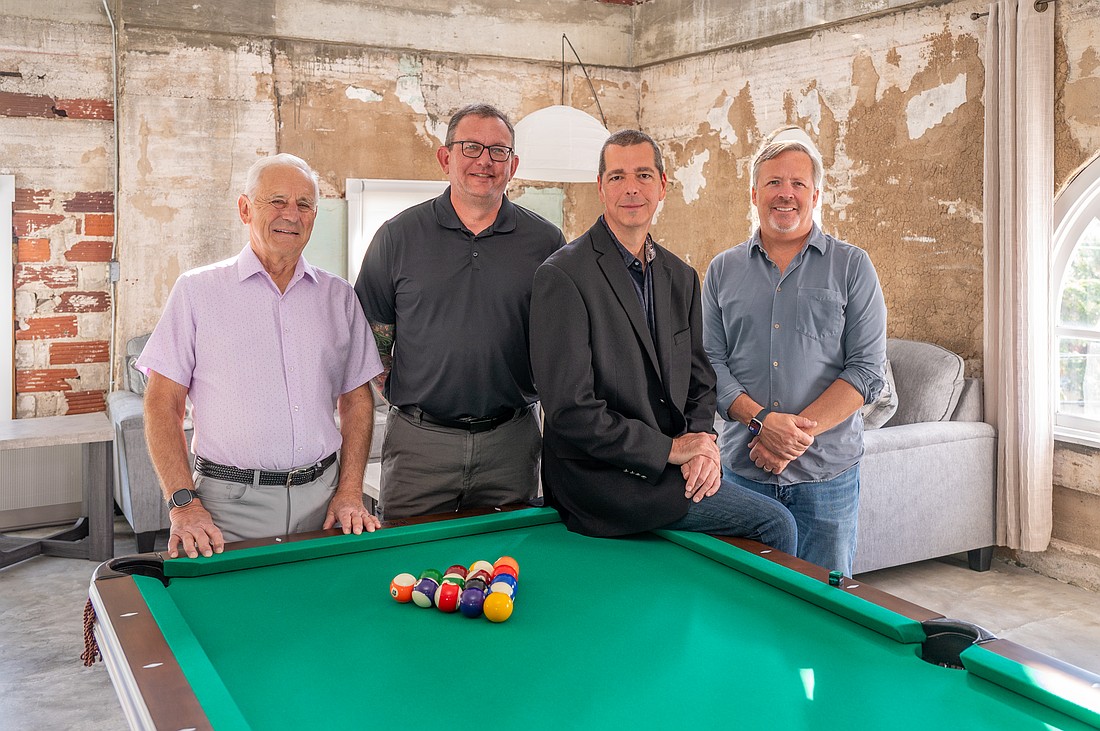
“Think of this as a factory that produces companies,” Priest says in an interview inside Suncoast Venture Studio’s headquarters in the Rosemary District alongside most of his leadership team.
Just north of downtown Sarasota, the office is on the third floor of a building on Central Avenue that was the first Black church in the area, built in 1926.
“It was built with donated or scavenged material,” says Suncoast Venture Studio COO Sean Dotson, who sold his robotics manufacturing company in 2021 to a private equity firm. ”It’s very eclectic, pulling in all pieces of the community, and it’s a great metaphor for what we’re trying to do — we’re trying to take pieces of the community and make something bigger.”
With pieces of its plan ranging from tech entrepreneurs to students to retirees, the studio aims to create what its founders say they hope will be a legacy of innovation in Sarasota — long known for its tourism and real estate development, sprinkled with a few homegrown tech giants.
A venture studio plays a hands-on role in building companies from the ground up. It differs from an incubator, which supports businesses in startup mode then lets them go off on their own, or a venture capital firm, which usually invests in startups that already exist.
“Instead of waiting on the entrepreneur with an idea to come to us,” says Priest, “we are coming up with the ideas.”
Ideas come internally, from a discussion with someone in the industry who needs a problem solved, from other companies or from a tech transfer opportunity, Priest says. (A tech transfer is the process of moving an innovation from a research institution like a university to another entity so it can be commercialized.)
At first, Suncoast Venture Studio will focus on technology ventures because “you can create them relatively quickly, and you don't need large teams or a large amount of capital to make them happen,” Priest says.
Once the studio has an idea, it will build the product, conduct market testing and create a business plan using an AI platform, Priest says. It then has to pitch the concept to its investment advisory board to determine whether to proceed.
“If we find something that we think is viable, then we will invite an experienced operator to come in,” Priest says. “That fundamentally turns the model upside down. By turning that model upside down and attracting the entrepreneurs here to run our businesses, we can build the tech infrastructure in our community one business at a time, and they'll stay here.”

To jump-start the businesses, Suncoast Venture Studio will put $250,000 to $500,000 into each venture then seek external funds, which will be an “important validation metric,” Priest says.
“We would be raising roughly between $500,000 and $2 million in investment capital, depending on the opportunity,” Priest says.
The goal is to have three to four concepts in seed stage by next year, according to Priest.
Currently, four business concepts are working their way through the Suncoast Venture Studio’s process, Priest says.
The studio's leaders are involved and invested in the ventures.
“When you see who's sitting in this table, they're all exited CEOs,” Priest says, surrounded by his C-suite. “The studio adds an incredible set of resources that the individual, solo entrepreneur doesn't have access to, which leads to better and faster success. That doesn't mean that everything we touch will turn to gold, but it does mean that we have a much higher likelihood of success, and we'll have multiple at bats.”
Once the studio is established, Priest says, “I think you’ll see us branch out into still tech-touched but other industries, like manufacturing, health care and maybe even issues that are related to coastal living."
Suncoast Venture Studio will use several metrics to measure success, including return on investor capital, says Priest. Another way the studio will assess its community impact will be by looking at how many ventures it produced and how many high-paying jobs it created, according to Priest, who says the goal is to generate three to four ventures a year for the first several years.
Already the studio is providing opportunities for local students. This summer, it hosted its first cohort of interns and is now on its second group for the fall semester, coming from New College in Sarasota.
“There's an opportunity of extending and building partnerships with a lot of the local educational institutions, from New College to Ringling to USF,” says Suncoast Venture Studio CMO Dan Alpert. He adds that colleges are "intrigued" by having their students collaborate in starting businesses from scratch. University of Florida is also in talks with the studio, according to Dotson.
Priest adds the studio could help stop “brain drain,” or the exodus of college graduates from the area, noting Disney and Pixar typically recruit Ringling College of Art and Design students.
“Wouldn't it be nice if we could now take the graduates they're producing and maybe provide opportunities to keep them here as well?” Priest says. “I think to some small extent, the studio will be able to contribute to some of that.”
In addition to graduates, the studio seeks to keep dollars and experience in the community.
At the moment, investments and expertise from retired executives in the Sarasota area are channeled to “Tampa, Orlando, Miami or even out of state, just because there’s not enough here,” Priest says. “You have all this demand for the ability to invest back in the local area but not enough supply. So the studio is providing the supply through, initially, tech-focused ventures.”
"It's not just one or two people that can actually build this company up successfully. We need to connect with lots of people in the community in order for this to work," says Suncoast Venture Studio co-founder and Chief Revenue Officer Will Dolan.
Both Dolan and Dotson cite population growth in the Sarasota area as a factor in bringing the studio together now.
"We saw a large influx of tech people come to this area" during the pandemic, Dotson says, due to the capacity for remote work. "Combine that with the retired executives and capital and leadership, and this is the time right now for [the studio] to happen."
The greatest challenge for the studio will be finding founders for its startup companies, according to Priest.
“It's an incredible amount of work, and it takes a very specific personality and grit and experience in the industry that we’re targeting,” Priest says.
“We're looking for four-leaf clovers, and our tech ecosystem is just growing, so we don't have all of that here," Priest says. "The No. 1 thing that I'll be working on is trying to attract those founders and get them to fall in love with Sarasota.”