- February 3, 2026

-
-
Loading
Loading
Recently, the Florida Housing Coalition, along with the Gulf Coast Community Foundation, Barancik Foundation, Patterson Foundation and the Community Foundation of Sarasota released a Sarasota Housing Action Plan diagnosing the county’s housing crisis and recommending some approaches to fixing it.
The report provides valuable and much needed data and analysis, and we commend the partners for their foresight and commitment to producing it.
The Housing Action Plan rightly diagnoses the symptoms of housing stress — cost burdens, displacement pressure and a growing mismatch between income levels and housing costs. But it does so while clinging to an outdated paradigm of housing policy.
The report largely recommends that Sarasota continue a lot more of what it has been doing to address housing needs. Its recommendations get some things right and some things wrong, but mostly they hew to existing approaches that have helped, but cannot ultimately solve our housing problems.
Indeed, we are seeing other fast-growing metro areas around the country succeeding at solving housing problems by using different approaches.
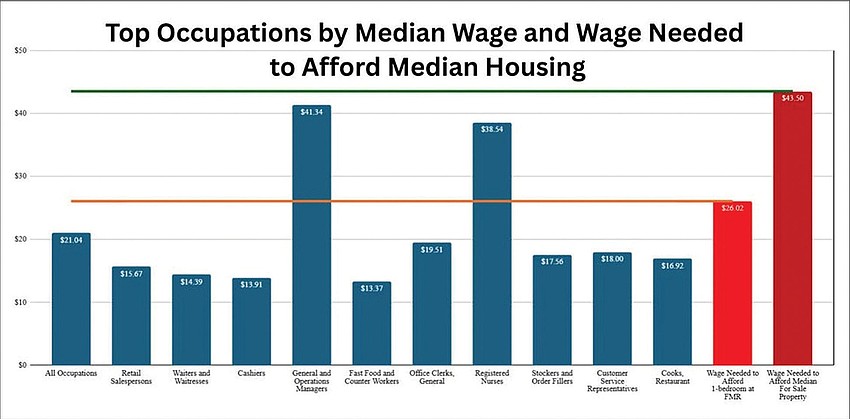
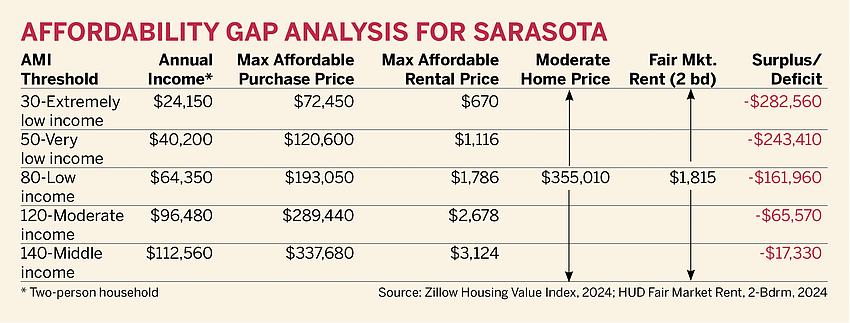
As the accompanying graph shows, a useful way to envision Sarasota’s housing problem is to look at how few homes in the region are affordable for most of the region’s workers. The report notes that more than 47,000 low-income households in Sarasota pay more than 30% of income on housing and that nearly 25,500 pay more than 50%.
What the report does not point out is of the 71,000 newly built homes in Sarasota County from 2000 to 2024, only 2,300 (3%) were single-family attached units on smaller lots. These include small lot single-family, townhouses, duplexes or backyard cottages.
If just 20% of that land used for detached homes (single-family, one home per lot) had instead hosted SFAs, Sarasota could have added 44,000 more moderately priced homes, many affordable to essential workers like nurses, teachers and first responders.
The Housing Action Plan does endorse many approaches that experience has shown would help improve the region’s housing situation. Notably:
These measures would help the region’s housing supply, but mostly at the margins. The second item is the key to really solving the problem, but it is not given enough emphasis in the report, which also does not point out how zoning reforms around the country have been successful.
The number one recommendation of the Housing Action Plan is to expand use of incentives and subsidies — from government construction and ownership of affordable housing; to subsidizing the building of affordable housing; to incentivizing the sale of some properties at affordable prices by allowing developers to build more and denser projects if they set aside some units to sell below market.
While this may sound good on the surface, this is the approach that Sarasota has taken for decades, as have many other parts of the country. But these approaches have failed to solve housing problems, and overall have made housing less affordable.
Indeed, housing provided through subsidies and incentives has proven to be slowly incremental at best compared to needs and drives up the cost of other housing. Every subsidy given to one requires that someone else must pay to cover the subsidy.
The report estimates a need for 15,000 affordable units in the region by 2035 — yet it fails to lay the groundwork meaningfully for a private-sector response that could meet this need, at scale, and without perennial public subsidy.
One of us has worked on housing policy for more than 50 years, another for more than 30 years, and the Florida Policy Project has spent the past two years focused on best practice research in housing affordability. Our focus has been on what works, what creates housing markets that are affordable, desirable and sustainable.
What Sarasota needs is to empower property owners, small builders and neighborhoods to build — legally, affordably and sustainably. What has worked around the country to achieve this are approaches that include:
By-right is when a project conforms to zoning and building codes and thus qualifies for construction with requiring a hearing process. Light-touch density refers to allowing duplexes, triplexes, townhomes and accessory dwelling units within existing single-family neighborhoods.
Such zoning changes are crucial. To its credit, the Housing Action Plan endorses this.
Sarasota County should legalize two- to eight-unit structures by right in existing lots in residential zones and set a minimum lot size of 1,400 square feet in new residential subdivisions.
These changes can yield thousands of affordable homes with prices under $400,000, compared to the $657,000 average for new detached homes.
These would be homes the county’s teacher, retail worker, restaurant and other typical service worker households can afford without subsidies.
Austin, Texas, has made aggressive use of these policies in recent years to allow more housing to be built, allow more density in parts of the city and allow a wider range of housing types. The result is that average rents dropped by 22%, about $400 a month.
Keeping permitting and other fees on new housing at reasonable levels and with quick processing time helps as well. The success of Anaheim’s Platinum Triangle, which added more than 4,500 homes on less than 1% of city land without price controls or subsidies, proves that ministerial approvals and density unlocks affordability.
Local governments simply cannot make housing supply happen in a way that comes close to keeping up with demand. But it can help lower income individuals and families afford housing by helping them make rent payments with housing vouchers.
If housing supply is permitted to keep up with demand, and developers are allowed to build enough low-cost housing units, vouchers can close the smaller gap that remains.
Altogether, the Housing Action Plan, while filled with data, sidesteps this fundamental truth: That housing scarcity is a policy choice.
The affordability crisis is not a market failure, but the result of shackling the market with zoning handcuffs and process bottlenecks.
Sarasota County does not need more subsidies. It needs a renaissance in abundant, naturally affordable housing driven by allowing more housing, lower cost housing and simpler and less costly approval processes, combined with focusing on removing barriers to private and philanthropic efforts to helping with housing needs.
Jeffrey Brandes is a former Florida state senator and president of the Florida Policy Project based in St. Petersburg.
Adrian Moore is vice president of Reason Foundation, a libertarian-oriented think tank. Moore lives in Sarasota.
Edward Pinto is co-director of the housing center at American Enterprise Institute and a long-time resident of St. Armands Key.