Sarasota cybersecurity firm combats evil on way to $100M goal

Tenex, which offers AI-native cybersecurity solutions, attributes its explosive growth to having the right product and team in place amid growing threats from cyber criminals.


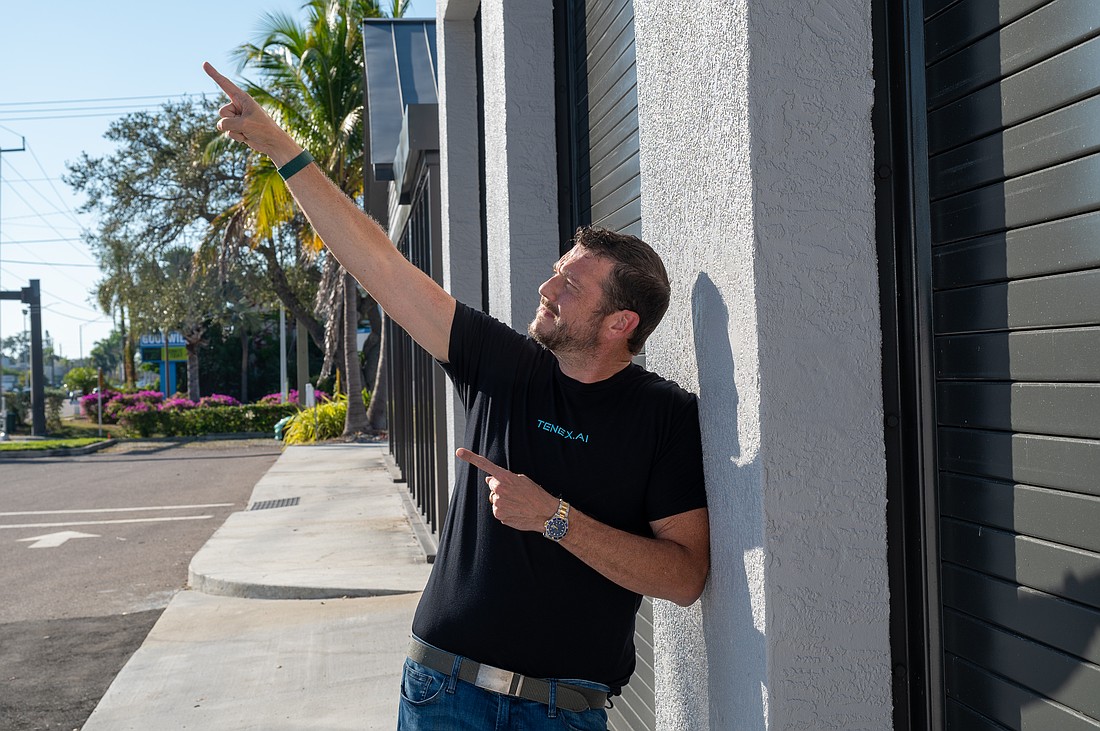
Tenex CEO Eric Foster is aiming for his company to hit $100 million in revenue. “It’s only a question of when," he says.
Photo by Lori Sax
  • Manatee-Sarasota
  • Share

The head of a rapidly expanding Sarasota-based cybersecurity company growing globally says he considers his job a “national and moral imperative” to combat evil. 

“The vast majority of cyber criminals are literally the alliance of evil,” Tenex CEO Eric Foster says. “These aren’t…the stereotypical teenage hacker in his mom’s basement. These are literal professional cyber criminals, usually nation-state operatives” from China, North Korea, Iran and Russia as well as organized crime groups fueling human trafficking and drug operations."

Following those lofty ideals, Foster is building what he believes will be a $100 million-plus business with some 100 employees locally — a significant accomplishment in the Sarasota-Manatee region, known more for hospitality and development companies than tech gazelles.

Tenex, which came out of stealth in January and has exceeded $18 million in revenue, is now growing its footprint and its workforce to meet what Foster says is the increasing demand for its AI-native cybersecurity services. Among its plans are a national headquarters in Sarasota, an office in Europe and more than 200 hires in the next year.

Tenex establishing its U.S. headquarters in Sarasota marks a "milestone for our region," says Erin Silk, president and CEO of the Economic Development Corporation of Sarasota County. "It’s not just a win for one company — it’s a win for Sarasota, for workforce development, for economic diversification and for positioning our region as a noteworthy hub in the competitive tech and business world."

As it grows its customer base, Tenex is on pace to exceed $40 million in revenue by April 2026, according to Foster.

“We're providing cybersecurity services to some of the biggest companies on the planet,” says Foster, whose clients are mainly in the financial sector; a number are Fortune 500 companies.

“Cyber criminals target banks,” Foster says, “because that’s where the money is.”

And it's a lot of money: Global cybercrime is projected to cost $10.5 trillion this year, according to market research firm Cybersecurity Ventures.

Foster, with a background in technology — he built and sold personal computers in high school in the 1990s and has been a cybersecurity executive for decades — attributes Tenex’s explosive growth to being “in the right place with the right product and the right team at the right time.”

Says Foster: “We've got a solution that is … better, faster, cheaper than competing approaches, and tremendous curiosity from customers on how AI can transform their security.”

Enabling it to scale, Tenex raised $27 million in Series A funding in September, led by California-based Crosspoint Capital Partners, with participation from investors Silicon Valley firms Andreessen Horowitz (a16z) and Shield Capital; German-based DTCP; Orlando venture capital firm DeepWork Capital; and the Florida Opportunity Fund.

The funding was "more about execution than just a capital raise," Shield Capital Venture Partner Elias "Lou" Manousos says. "It's really about validation, that we're seeing really strong growth — the company is executing. When a company is growing and you're adding more customers, the investment ... follows." 

Going forward, "we'll be raising more money, because we expect this momentum" to continue, says Manousos, who is also Tenex board chair. "We're excited about the next year of growth."


10x people

The name “Tenex” means 10x, or ten times something, according to Foster. He says that the concept has been around a long time, especially in software development.

“We believe in the 10x,” Foster says. “We believe that the best people, especially in creative work, are 10 times better than average, and we look … for those those kind of people.”

The company had nearly 70 employees in November and plans to have “just shy of 300” by the end of 2026, Foster says. That can be up to a 330% increase in payroll. 

Tenex has offices in Sarasota; Kansas City, Missouri; and San Jose. It also plans to open a location in Germany or the UK in 2026.

In Europe, the sector most targeted by cyber threats is public administration, according to the 2025 “Threat Landscape” report from the European Union Agency for Cybersecurity.

Tenex plans to “'move more into the public sector” in 2026, Foster says, while also focusing on critical infrastructure and its sweet spot: the financial sector.

Going forward, the growth plan will be to add about 200 people a year “for the foreseeable future,” Foster says. “We're growing much faster than we expected.”

The goal is to get to $100 million in revenue in the next fiscal year. 


AI native

Tenex is AI native, meaning it was developed using artificial intelligence. Its flagship product is its managed detection and response service, which uses AI agents to detect and handle cyber threats, escalating issues to humans as needed.

“We're not building a software product. We're building and selling business outcomes, and we do that in a way that is human first; it’s a big secret to our success,” Foster says. “It's not about using AI to take humans entirely out of the loop. It's about if I can take a human and make them 10 times more effective than they already are, [then] I'm going to hire a lot of humans, and I'm going to make them much more effective, and the AI is going to enable them to do that much more work.”

As an example, he says, think about a software developer getting paid $150,000 a year to produce $500,000 of positive impact for a business. With AI, he says, that person may be able to get 10 times more done, now producing $5 million in economic value.

“Essentially, what we're trying to do now is take the [cybersecurity] solutions that the biggest banks are using and bring them down at a lower cost to everybody,” Foster says. “It's truly our vision to bring cybersecurity to the masses that is better and faster and more cost-effective.”


Pro-business

To house its U.S. headquarters, Tenex is building an office complex at 2407 Bee Ridge Road in a space that used to house Smacks Burgers & Shakes. 

“I'm actually a huge believer in office culture,” Foster says. “People are more productive when they can … collaborate with somebody. When they need help, they can reach out for it.” 

For those less experienced, he adds: “If you're surrounded by some of the best, you learn faster, you accelerate faster. It's one of the reasons why we have these three physical offices."

Tenex CEO Eric Foster says his company is finishing buildout of its Sarasota headquarters at 2407 Bee Ridge Rd.
Photo by Lori Sax

He cites the “pro-business culture” and community as factors in basing his company in Sarasota County.

“Sarasota is paradise on earth,” Foster says, sitting outside a Gulf Gate coffee shop in November. “I think it's one of the best places to possibly be.”

In addition, he says: “There's become this nexus of cybersecurity companies and cybersecurity talent in and around the Tampa Bay area.”

Indeed, billion-dollar cybersecurity stalwarts such as Tampa-based ReliaQuest and Clearwater-based KnowBe4 — aka unicorns — are among the industry leaders in the region.

Foster says he believes the “next generation of workforce” will be created here in partnership with the CyberBay initiative, which launched in October in Tampa Bay with the backing of the University of South Florida to promote cybersecurity and AI innovation.


Finding talent

While having 150 current job openings presents a “logistical challenge,” Foster says, "We're not finding trouble hiring people."

Tenex will get a boost from a tech mogul in the region. Arnie Bellini, founder and CEO of Bellini Capital and founder of Tampa software company Connectwise, previously said in a statement that he plans to connect Tenex with advanced research partnerships, a “community of tech startups and solution builders” and top graduates from USF’s Bellini College of Artificial Intelligence, Cybersecurity and Computing, named after Bellini and his wife, who donated $40 million to the college.

Foster — who was an investor in Perch Security, which sold to Connectwise in 2020 — says he and Bellini are “kindred spirits” who “believe in cybersecurity as a true national and moral imperative" and think "we need to bring many more people into it, that we need to democratize it more, that we need to drive down the cost and drive up the efficacy."

In addition to getting help from USF and Bellini, Tenex offers “aggressive relocation packages," Foster says, adding: “We've already relocated a couple people that are absolute world-class hires,” including one from Uber. 

Excluding executive hires, the average salary at Tenex is $220,000 on-target earnings, including cash, bonus and equity, according to Foster.

And, he says, he’s not always looking to hire someone with the most experience. While “we truly are just trying to hire the best,” Foster says, “we really believe that we can hire a lot of entry-level talent and develop them.”

In Kansas City, Tenex partnered with a tech academy that designed a program for students who turned out to be “fantastic hires,” he says. “In fact, some of the best people I've hired in my career — one person specifically that I can point to — we hired right out of high school.”


Mission-driven

Part of what attracts people to work for Tenex, according to Foster, is its mission-driven culture.

“You're actually going to come with us and fight evil every single day; you're going to give good the advantage,” Foster says. “You're going to make a true difference.”

For the entirety of his 33-year career in cybersecurity, Foster says: “The bad guys have been winning.” 

AI is changing the dynamics, he says, making it possible for cybersecurity to become more nimble.

“Now is the first time in history that I stand here as a general on the field going, we are going to be able to take ground from the enemy,” Foster says. “I want to be at the forefront of that report that says, instead of $1.5 trillion that we lost to cyber crime, it's now even $1.4 [trillion]...It's a constant fight against evil. But we believe we can turn the tide. We can shrink the losses, we can make companies more secure, harder targets, and if we can really, truly do that, that is our mission. That is how we're going to change the world.”


author

Elizabeth King

Elizabeth is a business news reporter with the Business Observer, covering primarily Sarasota-Bradenton, in addition to other parts of the region. A graduate of Johns Hopkins University, she previously covered hyperlocal news in Maryland for Patch for 12 years. Now she lives in Sarasota County.

Latest News

Sponsored Content