Rays CEO talks childhood baseball, fan experiences and new ballparks

Ken Babby, who recently took over as one of the owners of the Tampa Bay Rays, says baseball is a game that creates bonds and wants those memories made at Tropicana Field and a new ballpark.


  • By Louis Llovio
  • | 5:00 a.m. December 18, 2025
  • | 2 Free Articles Remaining!
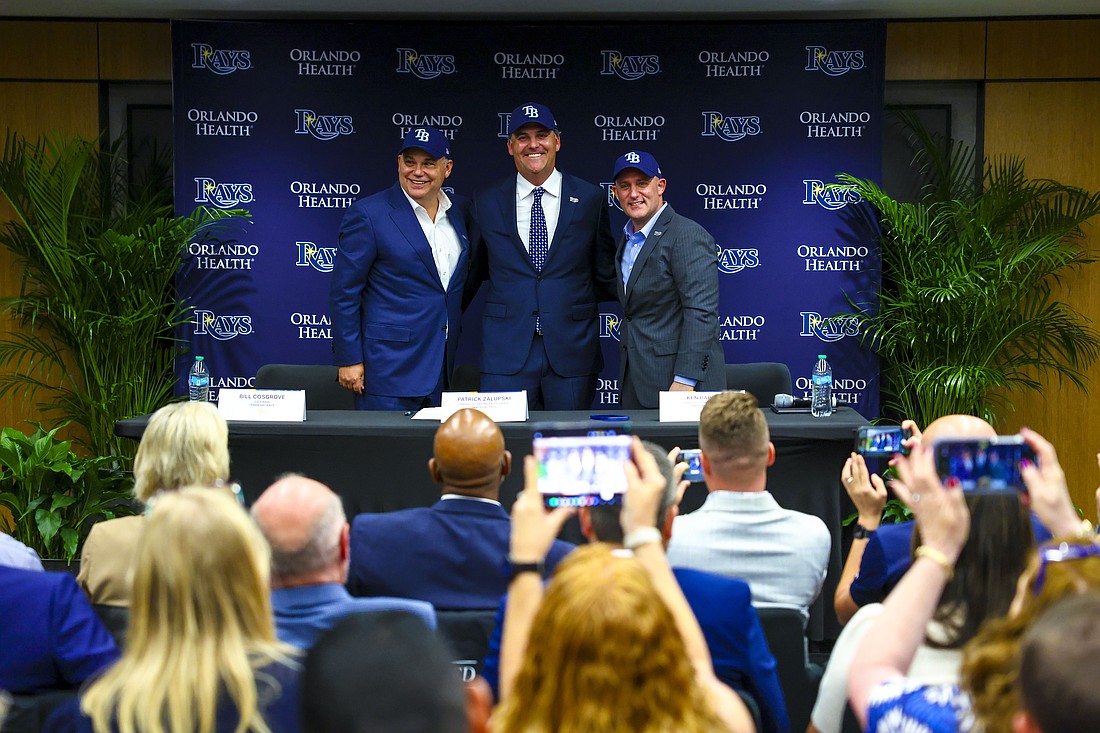
The Tampa Bay Rays new owners dawn caps on Oct. 7. L-to-R Bill Cosgrove, co-chair; Patrick Zalupski, managing partner co-chair; Ken Babby, chief executive officer.
Courtesy image
  • Tampa Bay-Lakeland
  • Share

Just a few months after taking over day-to-day operations of the Tampa Bay Rays, Ken Babby is absorbed on two tasks: Finding a new, permanent home for his team and creating a better fan experience at its current home.

Babby, 47, is the team’s CEO, a job he started earlier this year when the Rays sold to an ownership group — which he is a part of — led by Jacksonville homebuilder Patrick Zalupski.

A former media executive with the Washington Post and the former owner of two minor league baseball teams, the Jacksonville Jumbo Shrimp and Akron RubberDucks, Babby has been around professional baseball all his life, once serving as a bat boy for the Baltimore Orioles during Spring Training.

Ken Babby is the chief executive officer of the Tampa Bay Rays.
Ken Babby is the CEO of the Tampa Bay Rays.
Courtesy image

He got the exposure to the game because of his father, Lon Babby, who was the team’s general counsel at the time. In that job, the senior Babby played a big role in getting Camden Yards — a baseball stadium in downtown Baltimore that combined modern amenities with the spirit, heart and architecture of the classic ballparks — built. (It opened in 1992.)

Ken Babby remembers going to games at Memorial Stadium, the team’s previous ballpark, with his father. “The Orioles, in those years, as you remember, were not the most stellar, right? In 1988 they lost the first foot 21 games in a row.”

“But,” he adds in a statement that rings true to the fan base of the team he now runs, “there was a need for a new ballpark, and I think everybody understood that.”

Today, Babby sees that the private/public partnership that led to the construction of Camden Yards as an example of what can be done “to create something that creates jobs, that drives billions of dollars of economic growth.”

Babby attended Major League Baseball’s Winter Meetings in Orlando last week. He spoke to the Business Observer from an Uber in between meetings about his and his partners' plans for the coming year; how the search for a site for new ballpark is going; what fans can expect when they come back to Tropicana Field; and his love of the game.

Edited excerpts: 


Owning an MLB team

First and foremost, we're just a couple of months into our work, both in terms of our business strategy and our work towards a plan for the new ballpark. We’re still learning what's driving the business.

The first winter meeting, obviously, is a chance to be with our team, to be alongside the folks that work so hard year-round to make everything the Rays do successful.


2026 priorities

On one hand, we are laser focused on April of '26 and getting back into Tropicana Field. That's a really important part of our work. We are working alongside St. Petersburg and our partners to make sure that the deadline is met and that we reach that goal. And we are continuing as best as we can to stay focused on that work.

But also, at the same time, we are working on our ballpark project and finding the forever home of the Tampa Bay Rays — looking at different sites, understanding feasibility analysis of those different sites. And that work is ongoing.


Camden Yards comparisons 

The needs of fans have changed, right? So, in the 90s it was about just building a ballpark. We're really focused on a broader development that will obviously have an anchor to it as a ballpark. But it's beyond the ballpark, it’s a district. It’s a community.

The idea here is that this would have world-class amenities and a music venue, and a number of different attributes. A development having energy beyond just baseball games and special events.

Camden Yards is a great example of what happens when the public sector and clubs come together to create something that creates jobs, that drives billions of dollars of economic growth. We've seen that across the country in a number of these different mixed-use projects. And that's the work that we've got ahead of us.


Minor League Baseball lessons

Minor League Baseball was a wonderful sort of proving ground for what's possible in terms of creating great fan experiences and affordability and accessibility. We've had the opportunity to have a front row seat to do that, both in Akron and Jacksonville, in terms of what we've seen with the Rubber Ducks and what we've seen with the Jumbo Shrimp. From our perspective, it has, in a meaningful way, been a wonderful proving ground to try a bunch of different things and see what resonates with fans.

I think Rays fans have a lot to look forward to in terms of the way that we think about fan experience, delivering that championship culture, that culture of excellence.

One of the things we've talked about are the improvements that we're making to Tropicana Field. We've talked about new accessible ticket prices, making games more affordable than they certainly have been in the past. And we'll talk more about the amenities, a new video board, new sound system, etc, all of which, will be privately funded.


Why baseball matters

Baseball has been my passion since I was young. I spent 14 years in the media business and loved my time there. But baseball's always been my passion.

Baseball is such a social experience, right? It creates an environment where people want to be with the people that they care most about, whether it be family or friends or folks at work; grandparents and grandkids; people on a first date. The game just naturally lends itself to that.

You've seen it up in Baltimore in terms of those kinds of experiences, and we want to be able to deliver those same experiences at Tropicana Field, not only this year but into the future in terms of the way that we think about finding our forever home and where the ballpark lands.

So that's been where our attention has been focused. And we look forward to continuing to evolve that at over time.


author

Louis Llovio

Louis Llovio is the deputy managing editor at the Business Observer. Before going to work at the Observer, the longtime business writer worked at the Richmond Times-Dispatch, Maryland Daily Record and for the Baltimore Sun Media Group. He lives in Tampa.

Latest News

Sponsored Content