- April 2, 2026

-
-
Loading
Loading
REVIEW SUMMARY
School. Argosy University, Tampa
Curriculum. Bachelor's, master's and doctorate degrees in limited areas
Key. Find a historic setting to offer advanced courses.
In the early 20th century, the role of lector was as important to Tampa cigar production as the people who did the actual rolling of Cuban tobacco.
The lector read novels or the daily paper aloud in three languages to workers inside the majestic brick buildings that are now part of the city's history, but are often underutilized.
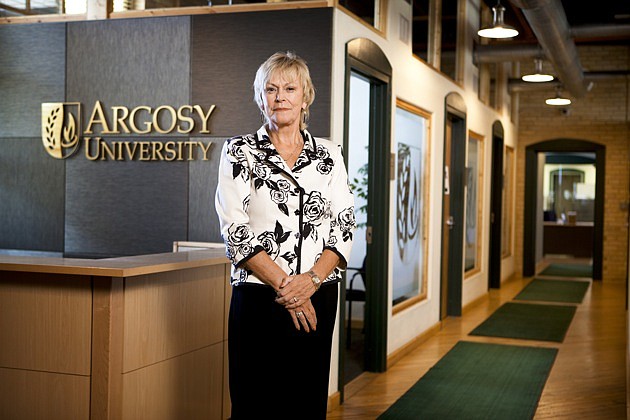
As Pat Meredith sees it, the old Berriman-Morgan Cigar Factory on North Howard Avenue at Interstate 275 is now coming full circle. As campus president of Argosy University, she is supervising full occupancy of the 107-year-old building where professors will now do the lecturing this fall.
While non-traditional college course offerings in modern office settings are certainly nothing new, Argosy departed from the norm when it signed a 10-year lease at the cigar building, which had been vacant the last three decades. The college, which offers advanced degrees in select disciplines, relocated last year from Tampa Bay Park along North Himes Avenue.
“It just gives you your own identity,” Meredith says of the three-story building, which also has a basement and is highly visible to I-275 motorists. The Argosy name is emblazoned on the building's interstate side, as well as on the factory's restored water tower.
Classes at Argosy's Tampa campus will begin Sept. 7, with an open house scheduled for July 20 to allow prospective students and others to see the refurbished interior.
Argosy offers master's and doctorate degree programs in business, education and psychology, along with bachelor's degrees in criminal justice and liberal arts, with more than 60 full-time employees plus adjunct professors from the local business community.
First in the door
Argosy became the building's first tenant since local engineer Nicholas Jammal bought and rehabilitated the building over the last several years. Jammal paid $600,000 for the 32,000-square-foot blond brick structure in 2004, then spent far more money bringing it back into service.
The Berriman-Morgan factory, named for two different cigar manufacturers that previously occupied it, opened in 1903 and had as many as 1,000 workers rolling more than 11 million Havana cigars by hand each year. It is among dozens of cigar factories dotting the landscape between downtown Tampa and the Westshore business district that somehow eluded the wrecking ball, with some preservationists arguing that the buildings are almost built too tough to be torn down.
Originally intended to become multi-tenant office and retail space as part of West Tampa's planned resurgence, the building's leasing efforts quickly turned to finding a single user. Argosy, which previously shared space with the Art Institute of Tampa, sought a more centralized location to establish its own identity.
The school originally planned to take one floor of the factory, then decided earlier this year to occupy the entire building. Chicago-based Argosy currently has 600 students at its Tampa campus, one of 19 across the country, yet now has the capacity for twice as many, according to Meredith.
Getting Argosy to envision an old cigar factory as its new campus took some doing, says Bob Zegota, a former broker at Grubb & Ellis|Commercial Florida. He and colleagues Rob Turner and Richard Andretta worked with Jammal to market his space, while Argosy scouted its own sites.
“At first they were hesitant, but as time went along they were convinced,” says Zegota, now senior director of special asset recovery for CLW Real Estate in Tampa. One selling point, he says, was signage visibility to the thousands of cars rolling by each day.
“It would give them prominence in the market,” he says. “There was no way anybody would not know that building. Nothing is more important for a school than to be recognized.”
Jammal points out that Argosy's occupancy of the cigar factory further extends the building's history, along with that of Tampa's heritage.
“This project has already provided, and will continue to provide, a living testimony to the fact that historical buildings can not only be restored to historic preservation standards, but also be restored in a manner that is conducive to business in a modern, technological world,” he says.
Writing new history
Meredith observes that the building provides an appropriate setting for Argosy's advanced degrees, which are also deeply rooted in history. Most classes are conducted nights and weekends to allow working professionals to further their education.
“We're not attracting traditional students,” she says, noting that the average age of Argosy students in Tampa is 37. “Sometimes you can't tell the students from the faculty here.”
While many of Argosy's classes are available online, giving students the choice of doing coursework at home, she believes some students will want to attend classes in person. “Some of them like the blend of coming in here and working on their own,” she says.
For those students who choose to show up for class, the setting should seem familiar to anyone who has ever been in a traditional campus building. The factory's old brick and mortar, wooden beams and restored staircases are reminiscent of buildings that have stood at colleges for generations, and the converted classrooms with narrow windows look like they have been in place for a lot longer than just this year.
Most textbooks and research materials for Argosy's classes can be found online, but there's a classic campus library available in the basement of the building. Lounge areas are also available, and a special outdoor walkway connects to the main conference room.
“The scheduling is unique, the space is unique and it sets us apart” from other competing local colleges offering degrees, Meredith says. Rather than attempting to offer a broad range of degrees, she says Argosy tends to stick to those it now offers.
Chances for growth
Although the recession and extended unemployment has tended to drive many professionals back to school to expand their knowledge, Meredith says most of the students she has seen enrolling at Argosy are secure in their current positions but seek advancement — an educator looking to become an administrator, for example.
Military personnel returning from service in the Middle East provide more opportunity for enrollment growth, she says, with Argosy offering to match government tuition assistance through the U.S. Department of Veterans Affairs' Yellow Ribbon Program.
Alliances with other local schools may bring more students and revenue in years to come. Meredith says Argosy recently signed an agreement with Hillsborough Community College, which has nearby campuses in Ybor City and on Dale Mabry Highway, allowing students to transfer credits from their two-year associate degrees.
“It definitely gives us an edge,” she says. “We've got to do our legwork now.”
Meredith says Argosy's Tampa building now has enough classroom and parking capacity to take between 1,000 and 1,200 students, though there may be opportunities to expand based on demand for course offerings, economic rebound and prospects for eventual redevelopment in West Tampa.
“I wouldn't be opposed to getting another cigar factory nearby,” she says.